Ch. 1 - Functions
Briggs - Calculus: Early Transcendentals 3rd Edition
Briggs3rd EditionCalculus: Early TranscendentalsISBN: 9780136847243Non è quello che usi tu?Cambia libro di testo
Capitolo 1, Problema 112b

Daylight function for 40 °N Verify that the function D(t)=2.8sin(2π365(t−81))+12D(t)=2.8\(\sin\)(\(\frac{2\pi}{365}\)(t-81))+12 has the following properties, where t is measured in days and D is the number of hours between sunrise and sunset.


Its maximum and minimum values are 14.8 and 9.2, respectively, which occur approximately at t=172t= 172  and t=355t = 355, respectively (corresponding to the solstices).

Guida verificata passo dopo passo
1
Identify the function given: \( D(t) = 2.8 \sin\left(\frac{2\pi}{365}(t-81)\right) + 12 \). This is a sinusoidal function representing daylight hours over a year.
Determine the amplitude of the function. The amplitude is the coefficient of the sine function, which is 2.8. This indicates the maximum deviation from the average daylight hours.
Calculate the average daylight hours. The average value of the function is the constant term, which is 12. This represents the average number of daylight hours over the year.
Find the maximum and minimum values of the function. The maximum value occurs when the sine function equals 1, giving \( 2.8 \times 1 + 12 = 14.8 \). The minimum value occurs when the sine function equals -1, giving \( 2.8 \times (-1) + 12 = 9.2 \).
Verify the days when these extrema occur. The maximum occurs when \( \sin\left(\frac{2\pi}{365}(t-81)\right) = 1 \), which corresponds to \( t = 172 \). The minimum occurs when \( \sin\left(\frac{2\pi}{365}(t-81)\right) = -1 \), which corresponds to \( t = 355 \). These align with the solstices.

Risposta video verificata per un problema simile:

Questa soluzione video è stata consigliata dai nostri tutor come utile per risolvere questo problema.
Durata del video:
9m

Concetti chiave

Ecco i concetti essenziali che devi comprendere per rispondere correttamente alla domanda.

Trigonometric Functions

Trigonometric functions, such as sine and cosine, are fundamental in calculus and describe periodic phenomena. In the context of the daylight function, the sine function models the variation in daylight hours throughout the year, reflecting the cyclical nature of seasons. Understanding how these functions behave, including their maximum and minimum values, is crucial for analyzing periodic data.
Video consigliato:
Percorso guidato
6:04
Introduction to Trigonometric Functions

Periodicity

Periodicity refers to the repeating nature of a function over a specific interval. For the daylight function, the period is 365 days, corresponding to the annual cycle of daylight variation. Recognizing the periodicity helps in predicting values at different times of the year and understanding the function's behavior over time.
Video consigliato:
Percorso guidato
5:43
Introduction to Tangent Graph

Maxima and Minima

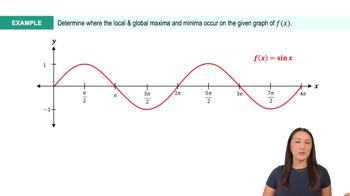
Maxima and minima are points where a function reaches its highest or lowest values, respectively. In the context of the daylight function, identifying these points (14.8 hours and 9.2 hours) is essential for understanding the extremes of daylight throughout the year. Techniques such as calculus can be used to find these critical points, which are significant for interpreting the function's practical implications.
Video consigliato:
02:13
Finding Extrema Graphically Example 3