Ch. 1 - Functions
Briggs - Calculus: Early Transcendentals 3rd Edition
Briggs3rd EditionCalculus: Early TranscendentalsISBN: 9780136847243Non è quello che usi tu?Cambia libro di testo
Capitolo 1, Problema 1.3.19

Evaluate each expression without a calculator.


a. log₁₀ 1000

Guida verificata passo dopo passo
1
Identify the base of the logarithm. In this case, the base is 10, as indicated by the subscript in log₁₀.
Recall the definition of a logarithm: \( \log_b(a) = c \) means \( b^c = a \).
Apply the definition to the given expression: \( \log_{10}(1000) = c \) means \( 10^c = 1000 \).
Recognize that 1000 can be expressed as a power of 10: \( 1000 = 10^3 \).
Conclude that since \( 10^c = 10^3 \), it follows that \( c = 3 \).

Risposta video verificata per un problema simile:

Questa soluzione video è stata consigliata dai nostri tutor come utile per risolvere questo problema.
Durata del video:
3m

Concetti chiave

Ecco i concetti essenziali che devi comprendere per rispondere correttamente alla domanda.

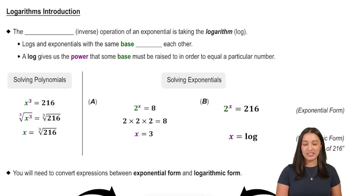
Logarithms

Logarithms are the inverse operations of exponentiation. The logarithm of a number is the exponent to which a base must be raised to produce that number. For example, in the expression log₁₀ 1000, we are looking for the power to which 10 must be raised to equal 1000.
Video consigliato:
7:30
Logarithms Introduction

Base of a Logarithm

The base of a logarithm indicates the number that is raised to a power. In log₁₀ 1000, the base is 10. Understanding the base is crucial because it determines the scale of the logarithmic function and how the values relate to one another.
Video consigliato:
05:36
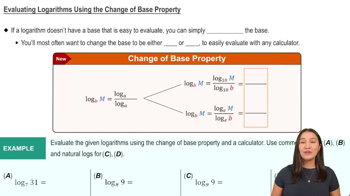
Change of Base Property

Properties of Logarithms

Logarithms have several key properties that simplify calculations. One important property is that logₐ (b * c) = logₐ b + logₐ c, which allows for the breaking down of complex logarithmic expressions. This property can be useful in evaluating logarithmic expressions without a calculator.
Video consigliato:
05:36
Change of Base Property