Ch. 1 - Functions
Briggs - Calculus: Early Transcendentals 3rd Edition
Briggs3rd EditionCalculus: Early TranscendentalsISBN: 9780136847243Non è quello che usi tu?Cambia libro di testo
Capitolo 1, Problema 1.89

Finding all inverses Find all the inverses associated with the following functions, and state their domains.


ƒ(x) = 2 / ( x² + 2)

Guida verificata passo dopo passo
1
The given function is \( f(x) = \frac{2}{x^2 + 2} \). This is a rational function where the numerator is a constant and the denominator is a quadratic expression.
To find the inverse, we need to solve for \( x \) in terms of \( y \). Start by setting \( y = \frac{2}{x^2 + 2} \).
Rearrange the equation to express \( x^2 + 2 \) in terms of \( y \): \( y(x^2 + 2) = 2 \). Then, solve for \( x^2 \): \( x^2 = \frac{2}{y} - 2 \).
Take the square root of both sides to solve for \( x \): \( x = \pm \sqrt{\frac{2}{y} - 2} \).
The expression \( \frac{2}{y} - 2 \) must be non-negative for the square root to be defined, so \( \frac{2}{y} \geq 2 \), which implies \( y \leq 1 \). Therefore, the domain of the inverse function is \( y \in (-\infty, 1] \).

Risposta video verificata per un problema simile:

Questa soluzione video è stata consigliata dai nostri tutor come utile per risolvere questo problema.
Durata del video:
6m

Concetti chiave

Ecco i concetti essenziali che devi comprendere per rispondere correttamente alla domanda.

Inverse Functions

An inverse function essentially reverses the effect of the original function. If a function f takes an input x and produces an output y, the inverse function f⁻¹ takes y back to x. For a function to have an inverse, it must be one-to-one, meaning each output is produced by exactly one input.
Video consigliato:
4:49
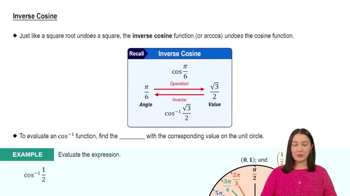
Inverse Cosine

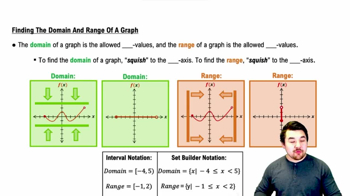
Domain and Range

The domain of a function is the set of all possible input values (x-values) that the function can accept, while the range is the set of all possible output values (y-values) that the function can produce. When finding the inverse of a function, the domain of the original function becomes the range of the inverse, and vice versa.
Video consigliato:
Percorso guidato
5:10
Finding the Domain and Range of a Graph

Finding Inverses Algebraically

To find the inverse of a function algebraically, you typically start by replacing f(x) with y, then swap x and y in the equation. After that, you solve for y to express it in terms of x. This new expression represents the inverse function, and it is important to also determine its domain based on the original function.
Video consigliato:
4:49
Inverse Cosine