Ch. 1 - Functions
Briggs - Calculus: Early Transcendentals 3rd Edition
Briggs3rd EditionCalculus: Early TranscendentalsISBN: 9780136847243Non è quello che usi tu?Cambia libro di testo
Capitolo 1, Problema 1.3.33

Find the inverse f−1(x)f^{-1}\(\left\)(x\(\right\)) of each function (on the given interval, if specified).
f(x)=2x2+1f\(\left\)(x\(\right\))=\(\frac{2}{x^2+1}\), for x≥0x\(\geq{0}\)

Guida verificata passo dopo passo
1
Start by setting the function equal to y: y = \(\frac{2}{x^2 + 1}\).
Swap x and y to find the inverse: x = \(\frac{2}{y^2 + 1}\).
Solve for y by first multiplying both sides by (y^2 + 1) to eliminate the fraction: x(y^2 + 1) = 2.
Expand and rearrange the equation to isolate y^2: xy^2 + x = 2, which simplifies to xy^2 = 2 - x.
Divide both sides by x to solve for y^2: y^2 = \(\frac{2 - x}{x}\), and then take the square root of both sides to solve for y, considering the domain x \(\geq\) 0 to ensure y is non-negative.

Risposta video verificata per un problema simile:

Questa soluzione video è stata consigliata dai nostri tutor come utile per risolvere questo problema.
Durata del video:
3m

Concetti chiave

Ecco i concetti essenziali che devi comprendere per rispondere correttamente alla domanda.

Inverse Functions

An inverse function reverses the effect of the original function. If a function f takes an input x and produces an output y, the inverse function f^{-1} takes y back to x. For a function to have an inverse, it must be one-to-one, meaning each output is produced by exactly one input. This property ensures that the inverse function is well-defined.
Video consigliato:
4:49
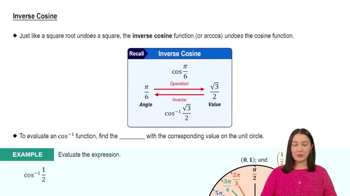
Inverse Cosine

Finding Inverses Algebraically

To find the inverse of a function algebraically, you typically start by replacing f(x) with y. Then, you solve for x in terms of y, and finally, swap the variables to express the inverse as y = f^{-1}(x). This process often involves algebraic manipulation, such as isolating x and may require additional steps like checking the domain and range of the original function.
Video consigliato:
4:49
Inverse Cosine

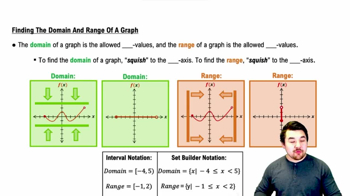
Domain and Range

The domain of a function is the set of all possible input values (x-values), while the range is the set of all possible output values (y-values). When finding an inverse function, it is crucial to consider the domain and range of both the original function and its inverse. The range of the original function becomes the domain of the inverse, and vice versa, which can affect the validity of the inverse in certain intervals.
Video consigliato:
Percorso guidato
5:10
Finding the Domain and Range of a Graph
Pratica correlata
Domanda del libro di testo

Finding all inverses Find all the inverses associated with the following functions, and state their domains.


ƒ(x) = 2 / ( x² + 2)

241
views

Domanda del libro di testo

Find the inverse f−1(x)f^{-1}\(\left\)(x\(\right\)) of each function (on the given interval, if specified).

f(x)=10−2xf\(\left\)(x\(\right\))=10^{-2x}

237
views
Domanda del libro di testo

Write the following logarithms in terms of the natural logarithm. Then use a calculator to find the value of the logarithm, rounding your result to four decimal places.


log660\(\log\)_660

340
views
Domanda del libro di testo

State whether the functions represented by graphs A , B , C and in the figure are even, odd, or neither. <IMAGE>

1340
views
Domanda del libro di testo

Solving equations Solve the following equations.


ln x= -1

334
views
Domanda del libro di testo

The National Weather Service releases approximately 70,00070,000 radiosondes every year to collect data from the atmosphere. Attached to a balloon, a radiosonde rises at about 10001000 ft/min until the balloon bursts in the upper atmosphere. Suppose a radiosonde is released from a point 66 ft above the ground and that 55 seconds later, it is 8383 ft above the ground. Let f(t)f\(\left\)(t\(\right\)) represent the height (in feet) that the radiosonde is above the ground tt seconds after it is released. Evaluate f(5)−f(0)5−0\(\frac{f\left(5\right)-f\left(0\right)}{5-0}\) and interpret the meaning of this quotient.

514
views