Ch. 1 - Functions
Briggs - Calculus: Early Transcendentals 3rd Edition
Briggs3rd EditionCalculus: Early TranscendentalsISBN: 9780136847243Non è quello che usi tu?Cambia libro di testo
Capitolo 1, Problema 1.1.59

Missing piece Let g(x) = x² + 3 Find a function ƒ  that produces the given composition.


(g o ƒ ) (x) = x⁴ + 3

Guida verificata passo dopo passo
1
Step 1: Understand the composition of functions. The composition (g o ƒ)(x) means g(ƒ(x)). We need to find a function ƒ(x) such that when we apply g to ƒ(x), we get x^4 + 3.
Step 2: Analyze the given function g(x) = x^2 + 3. Notice that g(x) takes an input, squares it, and then adds 3.
Step 3: To achieve the composition (g o ƒ)(x) = x^4 + 3, we need ƒ(x) such that when squared, it results in x^4. This suggests that ƒ(x) should be a function that, when squared, gives x^4.
Step 4: Consider the function ƒ(x) = x^2. When we apply g to ƒ(x), we have g(ƒ(x)) = g(x^2) = (x^2)^2 + 3 = x^4 + 3.
Step 5: Verify that the function ƒ(x) = x^2 satisfies the composition (g o ƒ)(x) = x^4 + 3. Therefore, ƒ(x) = x^2 is the function we are looking for.

Risposta video verificata per un problema simile:

Questa soluzione video è stata consigliata dai nostri tutor come utile per risolvere questo problema.
Durata del video:
4m

Concetti chiave

Ecco i concetti essenziali che devi comprendere per rispondere correttamente alla domanda.

Function Composition

Function composition involves combining two functions where the output of one function becomes the input of another. In this case, we are looking for a function ƒ such that when g is applied to ƒ, the result is a new function. This is denoted as (g o ƒ)(x), which means g(ƒ(x)). Understanding how to manipulate and combine functions is crucial for solving the problem.
Video consigliato:
3:48
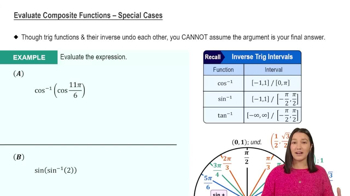
Evaluate Composite Functions - Special Cases

Quadratic and Polynomial Functions

The function g(x) = x² + 3 is a quadratic function, which is a specific type of polynomial function characterized by its degree of 2. The composition (g o ƒ)(x) results in a polynomial of degree 4, indicating that the function ƒ must also be a polynomial that, when composed with g, yields a higher degree polynomial. Recognizing the properties of polynomial functions helps in determining the form of ƒ.
Video consigliato:
6:04
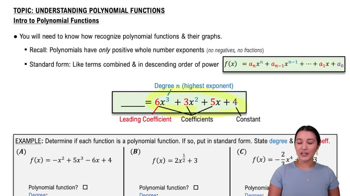
Introduction to Polynomial Functions

Finding Inverse Relationships

To find the function ƒ that satisfies the composition (g o ƒ)(x) = x⁴ + 3, we can think of it as finding an inverse relationship. This involves determining what input to g will produce the desired output. By setting g(ƒ(x)) equal to x⁴ + 3, we can derive ƒ(x) by manipulating the equation, which is essential for solving the problem effectively.
Video consigliato:
4:49
Inverse Cosine