
Ch. 1 - Functions
Briggs - Calculus: Early Transcendentals 3rd Edition
Briggs3rd EditionCalculus: Early TranscendentalsISBN: 9780136847243Non è quello che usi tu?Cambia libro di testo
Capitolo 1, Problema 54

Shifting a graph Use a shift to explain how the graph of ƒ(x)=−x2+8x+9ƒ(x)=\(\sqrt{-x^2+8x+9}\) is obtained from the graph of g(x)=25−x2g(x)=\(\sqrt{25-x^2}\) . Sketch a graph of ƒ.

Guida verificata passo dopo passo
1
Step 1: Recognize the form of the given functions. The function \( g(x) = \sqrt{25 - x^2} \) represents a semicircle with radius 5 centered at the origin on the x-axis.
Step 2: Rewrite the function \( f(x) = \sqrt{-x^2 + 8x + 9} \) in a form that reveals its relationship to \( g(x) \). Complete the square for the quadratic expression under the square root: \(-x^2 + 8x + 9\).
Step 3: Completing the square: \(-x^2 + 8x + 9 = -(x^2 - 8x) + 9 = -(x^2 - 8x + 16 - 16) + 9 = -(x - 4)^2 + 16 + 9 = -(x - 4)^2 + 25\).
Step 4: Now, the function \( f(x) \) can be rewritten as \( f(x) = \sqrt{25 - (x - 4)^2} \). This indicates that \( f(x) \) is a horizontal shift of \( g(x) \) by 4 units to the right.
Step 5: Sketch the graph of \( f(x) \) by taking the semicircle represented by \( g(x) \) and shifting it 4 units to the right. The new center of the semicircle is at \( (4, 0) \) with the same radius of 5.

Risposta video verificata per un problema simile:

Questa soluzione video è stata consigliata dai nostri tutor come utile per risolvere questo problema.
Durata del video:
7m

Concetti chiave

Ecco i concetti essenziali che devi comprendere per rispondere correttamente alla domanda.

Graph Shifting

Graph shifting refers to the process of moving a function's graph horizontally or vertically without altering its shape. This is achieved by adding or subtracting constants to the function's input (x) or output (y). For example, if a function f(x) is shifted to the right by 3 units, the new function becomes f(x - 3). Understanding this concept is crucial for analyzing how changes in the function's equation affect its graphical representation.
Video consigliato:
Percorso guidato
5:53
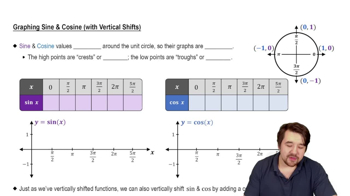
Graph of Sine and Cosine Function

Quadratic Functions

Quadratic functions are polynomial functions of degree two, typically expressed in the form f(x) = ax^2 + bx + c. The graph of a quadratic function is a parabola, which can open upwards or downwards depending on the sign of the coefficient 'a'. In the given question, the function f(x) = √(-x^2 + 8x + 9) can be analyzed by rewriting the expression under the square root as a quadratic, which helps in understanding its vertex and intercepts.
Video consigliato:
6:04
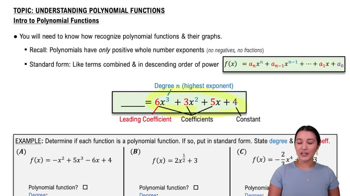
Introduction to Polynomial Functions

Square Root Functions

Square root functions are defined as f(x) = √(g(x)), where g(x) is a non-negative function. The graph of a square root function typically starts at a point on the x-axis and increases, reflecting the non-negative outputs of the square root. In the context of the question, understanding how the square root affects the shape and domain of the function is essential for sketching the graph of f(x) based on the transformations applied to g(x).
Video consigliato:
Percorso guidato
7:24
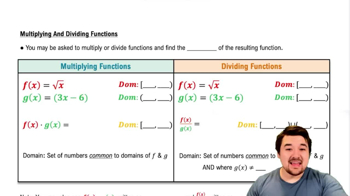
Multiplying & Dividing Functions