
Ch. 1 - Functions
Briggs - Calculus: Early Transcendentals 3rd Edition
Briggs3rd EditionCalculus: Early TranscendentalsISBN: 9780136847243Non è quello che usi tu?Cambia libro di testo
Capitolo 1, Problema 55d

Use shifts and scalings to transform the graph of ƒ(x)=x2ƒ(x)=x^2 into the graph of g. Use a graphing utility to check your work.
g(x)=6ƒ(x−23)+1g(x)=6ƒ(\(\frac{x-2}{3}\))+1

Guida verificata passo dopo passo
1
g(x) = 6ƒ\(\left\)(\(\frac{x-2}{3}\)\(\right\)) + 1 is a transformation of ƒ(x) = x^2.
Identify the inner transformation: ƒ\(\left\)(\(\frac{x-2}{3}\)\(\right\)) indicates a horizontal shift and scaling.
The expression \(\frac{x-2}{3}\) represents a horizontal shift to the right by 2 units and a horizontal scaling by a factor of 3.
The coefficient 6 outside the function ƒ indicates a vertical scaling by a factor of 6.
The +1 at the end of the expression indicates a vertical shift upwards by 1 unit.

Risposta video verificata per un problema simile:

Questa soluzione video è stata consigliata dai nostri tutor come utile per risolvere questo problema.
Durata del video:
7m

Concetti chiave

Ecco i concetti essenziali che devi comprendere per rispondere correttamente alla domanda.

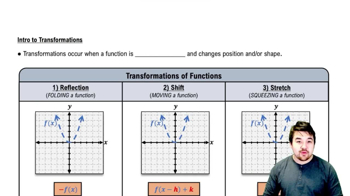
Transformations of Functions

Transformations of functions involve shifting, stretching, compressing, or reflecting the graph of a function. In this context, the function ƒ(x) = x² is transformed into g(x) through a series of operations, including horizontal shifts (x - 2), vertical stretches (multiplying by 6), and vertical shifts (adding 1). Understanding these transformations is crucial for accurately modifying the graph.
Video consigliato:
Percorso guidato
5:25
Intro to Transformations

Horizontal and Vertical Shifts

Horizontal and vertical shifts are specific types of transformations that move the graph of a function without altering its shape. A horizontal shift occurs when the input variable x is adjusted, such as in (x - 2), which shifts the graph 2 units to the right. A vertical shift, like adding 1 to the function, moves the graph up by 1 unit. Recognizing these shifts helps in visualizing the new position of the graph.
Video consigliato:
Percorso guidato
5:25
Intro to Transformations

Scaling and Stretching

Scaling and stretching refer to the changes in the graph's size and shape. When a function is multiplied by a constant, such as 6 in g(x), it vertically stretches the graph, making it taller. Conversely, if a fraction is applied to the input, like dividing by 3, it horizontally stretches the graph, making it wider. These concepts are essential for understanding how the graph of g(x) relates to the original function ƒ(x).
Video consigliato:
Percorso guidato
5:25
Intro to Transformations