Ch. 10 - Sequences and Infinite Series
Briggs - Calculus: Early Transcendentals 3rd Edition
Briggs3rd EditionCalculus: Early TranscendentalsISBN: 9780136847243Non è quello che usi tu?Cambia libro di testo
Capitolo 10, Problema 10.8.47

11–86. Applying convergence tests Determine whether the following series converge. Justify your answers.
∑ (from k = 1 to ∞) (4k)! / (k!)⁴

Guida verificata passo dopo passo
1
First, identify the general term of the series: \(a_k = \frac{(4k)!}{(k!)^4}\).
Since the terms involve factorials, consider using the Ratio Test to determine convergence. The Ratio Test states that for \(a_k\), compute \(L = \lim_{k \to \infty} \left| \frac{a_{k+1}}{a_k} \right|\).
Write the ratio \(\frac{a_{k+1}}{a_k} = \frac{(4(k+1))!}{((k+1)!)^4} \times \frac{(k!)^4}{(4k)!}\) and simplify this expression carefully by expanding factorials where possible.
Evaluate the limit \(L\) as \(k\) approaches infinity. If \(L < 1\), the series converges absolutely; if \(L > 1\), the series diverges; if \(L = 1\), the test is inconclusive.
Based on the value of \(L\), conclude whether the series converges or diverges, providing justification from the Ratio Test result.

Risposta video verificata per un problema simile:

Questa soluzione video è stata consigliata dai nostri tutor come utile per risolvere questo problema.
Durata del video:
4m

Concetti chiave

Ecco i concetti essenziali che devi comprendere per rispondere correttamente alla domanda.

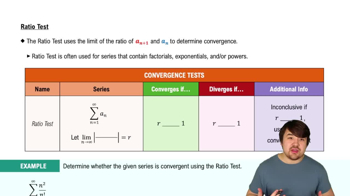
Ratio Test

The Ratio Test is used to determine the convergence of a series by examining the limit of the absolute value of the ratio of consecutive terms. If this limit is less than 1, the series converges absolutely; if greater than 1, it diverges. This test is especially useful for series involving factorials or exponential terms.
Video consigliato:

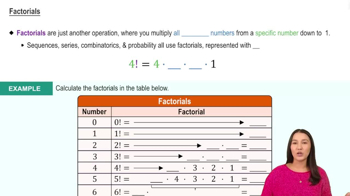
Factorials and Combinatorial Expressions

Factorials (n!) represent the product of all positive integers up to n and often appear in series terms. Understanding how to manipulate factorial expressions, such as simplifying ratios of factorials, is crucial for applying convergence tests effectively, especially when terms involve complex factorial combinations like (4k)!/(k!)⁴.
Video consigliato:
5:22
Factorials

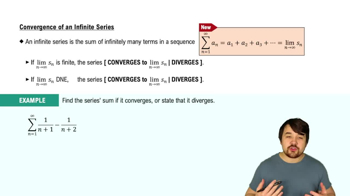
Convergence of Series

A series converges if the sum of its infinite terms approaches a finite limit. Determining convergence involves applying tests like the Ratio Test or Root Test and understanding the behavior of terms as k approaches infinity. Justifying convergence requires clear reasoning based on these tests and the nature of the series terms.
Video consigliato:
Percorso guidato
06:52
Convergence of an Infinite Series