Ch. 10 - Sequences and Infinite Series
Briggs - Calculus: Early Transcendentals 3rd Edition
Briggs3rd EditionCalculus: Early TranscendentalsISBN: 9780136847243Non è quello che usi tu?Cambia libro di testo
Capitolo 10, Problema 10.8.73

11–86. Applying convergence tests Determine whether the following series converge. Justify your answers.


∑ (from k = 0 to ∞)k² · 1.001⁻ᵏ

Guida verificata passo dopo passo
1
Identify the given series: \( \sum_{k=0}^{\infty} k^{2} \cdot 1.001^{-k} \). Notice that the general term is \( a_k = k^{2} \cdot (1.001)^{-k} \).
Rewrite the term to see the exponential part clearly: \( a_k = k^{2} \cdot \left( \frac{1}{1.001} \right)^{k} \). Since \( \frac{1}{1.001} < 1 \), this suggests the terms involve a polynomial factor times an exponential decay.
Consider applying the Ratio Test, which is useful for series involving factorials, exponentials, or powers. The Ratio Test states to compute \( L = \lim_{k \to \infty} \left| \frac{a_{k+1}}{a_k} \right| \).
Calculate \( \frac{a_{k+1}}{a_k} = \frac{(k+1)^2 \cdot (1.001)^{-(k+1)}}{k^2 \cdot (1.001)^{-k}} = \frac{(k+1)^2}{k^2} \cdot \frac{1}{1.001} \).
Evaluate the limit \( L = \lim_{k \to \infty} \frac{(k+1)^2}{k^2} \cdot \frac{1}{1.001} = \left( \lim_{k \to \infty} \frac{(k+1)^2}{k^2} \right) \cdot \frac{1}{1.001} = 1 \cdot \frac{1}{1.001} < 1 \). Since \( L < 1 \), the Ratio Test confirms that the series converges.

Risposta video verificata per un problema simile:

Questa soluzione video è stata consigliata dai nostri tutor come utile per risolvere questo problema.
Durata del video:
2m

Concetti chiave

Ecco i concetti essenziali che devi comprendere per rispondere correttamente alla domanda.

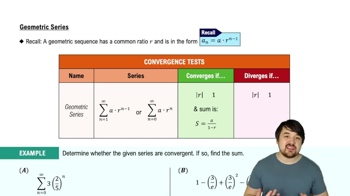
Geometric Series and Its Convergence

A geometric series has terms of the form ar^k, where r is the common ratio. It converges if |r| < 1 and diverges otherwise. Understanding this helps analyze series with exponential terms like 1.001⁻ᵏ, which can be rewritten as (1/1.001)^k, a geometric term with ratio less than 1.
Video consigliato:
Percorso guidato
06:00
Geometric Series

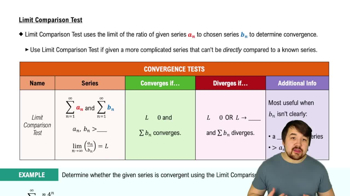
Comparison and Limit Comparison Tests

These tests compare a given series to a known benchmark series to determine convergence. The limit comparison test is useful when terms involve polynomials and exponentials, helping to confirm if the series behaves like a convergent geometric series despite polynomial factors like k².
Video consigliato:
Percorso guidato
07:45
Limit Comparison Test

Effect of Polynomial Factors on Series Convergence

Polynomial terms like k² grow slower than exponential decay terms. When combined with a geometric term with ratio less than 1, the exponential decay dominates, often ensuring convergence. Recognizing this balance is key to justifying convergence in series with mixed polynomial and exponential terms.
Video consigliato:
08:26
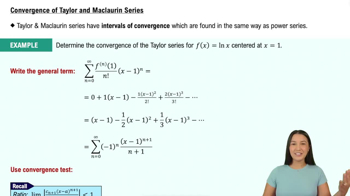
Convergence of Taylor & Maclaurin Series