
Domanda del libro di testo
11–27. Alternating Series Test Determine whether the following series converge.
∑ (k = 1 to ∞) (−1)ᵏ⁺¹ k² / (k³ + 1)
62
views

 Guida verificata passo dopo passo
 06:52
06:52
 07:15
07:15 06:00
06:0011–27. Alternating Series Test Determine whether the following series converge.
∑ (k = 1 to ∞) (−1)ᵏ⁺¹ k² / (k³ + 1)
45–63. Absolute and conditional convergence Determine whether the following series converge absolutely, converge conditionally, or diverge.
∑ (k = 1 to ∞) cos(k) / k³
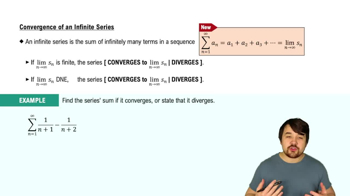
54–69. Telescoping series
For the following telescoping series, find a formula for the nth term of the sequence of partial sums {Sₙ}. Then evaluate limₙ→∞ Sₙ to obtain the value of the series or state that the series diverges.
59. ∑ (k = –3 to ∞) 4 / ((4k – 3)(4k + 1))
33–38. {Use of Tech} Remainders in alternating series Determine how many terms of the following convergent series must be summed to be sure that the remainder is less than 10⁻⁴ in magnitude. Although you do not need it, the exact value of the series is given in each case.
ln 2 = ∑ (k = 1 to ∞) (−1)ᵏ⁺¹ / k
55–70. More sequences
Find the limit of the following sequences or determine that the sequence diverges.
{cosn / n}
11–86. Applying convergence tests Determine whether the following series converge. Justify your answers.
∑ (from k = 1 to ∞) 2ᵏ / (3ᵏ − 2ᵏ)