
Ch. 10 - Sequences and Infinite Series
Briggs - Calculus: Early Transcendentals 3rd Edition
Briggs3rd EditionCalculus: Early TranscendentalsISBN: 9780136847243Non è quello che usi tu?Cambia libro di testo
Capitolo 10, Problema 10.2.65

55–70. More sequences
Find the limit of the following sequences or determine that the sequence diverges.


{cosn / n}

Guida verificata passo dopo passo
1
Identify the given sequence as \( a_n = \frac{\cos n}{n} \), where \( n \) is a positive integer.
Recall that \( \cos n \) oscillates between -1 and 1 for all integer values of \( n \), so the numerator is bounded.
Note that the denominator \( n \) increases without bound as \( n \to \infty \).
Use the Squeeze Theorem by bounding the sequence: since \( -1 \leq \cos n \leq 1 \), we have \( -\frac{1}{n} \leq \frac{\cos n}{n} \leq \frac{1}{n} \).
Since both \( -\frac{1}{n} \) and \( \frac{1}{n} \) approach 0 as \( n \to \infty \), conclude that \( \lim_{n \to \infty} \frac{\cos n}{n} = 0 \).

Risposta video verificata per un problema simile:

Questa soluzione video è stata consigliata dai nostri tutor come utile per risolvere questo problema.
Durata del video:
1m

Concetti chiave

Ecco i concetti essenziali che devi comprendere per rispondere correttamente alla domanda.

Limit of a Sequence

The limit of a sequence is the value that the terms of the sequence approach as the index n goes to infinity. If the terms get arbitrarily close to a specific number, the sequence converges to that limit; otherwise, it diverges.
Video consigliato:
8:22
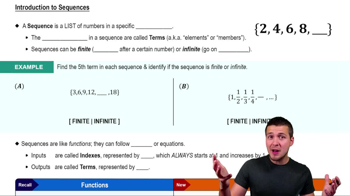
Introduction to Sequences

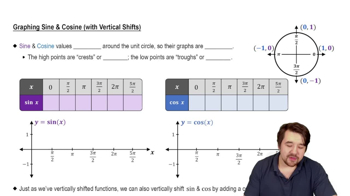
Behavior of the Cosine Function

The cosine function oscillates between -1 and 1 for all real numbers n. Since cos(n) does not approach a single value as n increases, it is important to consider how this oscillation affects the sequence when combined with other terms.
Video consigliato:
Percorso guidato
5:53
Graph of Sine and Cosine Function

Squeeze Theorem for Sequences

The Squeeze Theorem states that if a sequence is bounded above and below by two sequences that both converge to the same limit, then the original sequence also converges to that limit. This is useful when dealing with sequences involving bounded oscillating functions divided by terms that grow without bound.
Video consigliato:
8:22
Introduction to Sequences
Pratica correlata
Domanda del libro di testo

54–69. Telescoping series

For the following telescoping series, find a formula for the nth term of the sequence of partial sums {Sₙ}. Then evaluate limₙ→∞ Sₙ to obtain the value of the series or state that the series diverges.


59. ∑ (k = –3 to ∞) 4 / ((4k – 3)(4k + 1))

119
views
Domanda del libro di testo

33–38. {Use of Tech} Remainders in alternating series Determine how many terms of the following convergent series must be summed to be sure that the remainder is less than 10⁻⁴ in magnitude. Although you do not need it, the exact value of the series is given in each case.


ln 2 = ∑ (k = 1 to ∞) (−1)ᵏ⁺¹ / k

70
views
Domanda del libro di testo

11–86. Applying convergence tests Determine whether the following series converge. Justify your answers.


∑ (from k = 1 to ∞)(1 + 1 / (2k))ᵏ

42
views
Domanda del libro di testo

51–56. {Use of Tech} Recurrence relations Consider the following recurrence relations. Make a table with at least ten terms and determine a plausible limit of the sequence or state that the sequence diverges.


aₙ₊₁ = 4aₙ + 1 a₀ = 1

57
views
Domanda del libro di testo

84–87. {Use of Tech} Sequences by recurrence relations

The following sequences, defined by a recurrence relation, are monotonic and bounded, and therefore converge by Theorem 10.5.


a.Examine the first three terms of the sequence to determine whether the sequence is nondecreasing or nonincreasing.

b.Use analytical methods to find the limit of the sequence.


aₙ₊₁ = 2aₙ(1 − aₙ);a₀ = 0.3

76
views
Domanda del libro di testo

11–86. Applying convergence tests Determine whether the following series converge. Justify your answers.

∑ (from k = 1 to ∞) 2ᵏ / (3ᵏ − 2ᵏ)

66
views