Ch. 10 - Sequences and Infinite Series
Briggs - Calculus: Early Transcendentals 3rd Edition
Briggs3rd EditionCalculus: Early TranscendentalsISBN: 9780136847243Non è quello che usi tu?Cambia libro di testo
Capitolo 10, Problema 10.8.49

11–86. Applying convergence tests Determine whether the following series converge. Justify your answers.
∑ (from k = 1 to ∞)(⁵√k) / ⁵√(k⁷ + 1)

Guida verificata passo dopo passo
1
First, rewrite the general term of the series to better understand its behavior: the term is given by \(\frac{\sqrt[5]{k}}{\sqrt[5]{k^{7} + 1}}\).
Simplify the expression inside the fifth root in the denominator by factoring out \(k^{7}\): \(\sqrt[5]{k^{7} + 1} = \sqrt[5]{k^{7}(1 + \frac{1}{k^{7}})}\).
Use the property of roots to separate the terms: \(\sqrt[5]{k^{7}(1 + \frac{1}{k^{7}})} = \sqrt[5]{k^{7}} \cdot \sqrt[5]{1 + \frac{1}{k^{7}}} = k^{\frac{7}{5}} \cdot \sqrt[5]{1 + \frac{1}{k^{7}}}\).
Rewrite the original term as \(\frac{k^{\frac{1}{5}}}{k^{\frac{7}{5}} \cdot \sqrt[5]{1 + \frac{1}{k^{7}}}} = \frac{1}{k^{\frac{6}{5}} \cdot \sqrt[5]{1 + \frac{1}{k^{7}}}}\).
As \(k\) approaches infinity, \(\sqrt[5]{1 + \frac{1}{k^{7}}}\) approaches 1, so the term behaves like \(\frac{1}{k^{\frac{6}{5}}}\). Use the p-series test to determine convergence: since \(\frac{6}{5} > 1\), the series converges.

Risposta video verificata per un problema simile:

Questa soluzione video è stata consigliata dai nostri tutor come utile per risolvere questo problema.
Durata del video:
6m

Concetti chiave

Ecco i concetti essenziali che devi comprendere per rispondere correttamente alla domanda.

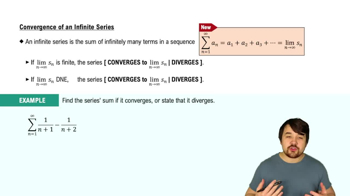
Convergence of Infinite Series

An infinite series converges if the sequence of its partial sums approaches a finite limit. Understanding convergence is essential to determine whether the sum of infinitely many terms results in a finite value or diverges to infinity or oscillates.
Video consigliato:
Percorso guidato
06:52
Convergence of an Infinite Series

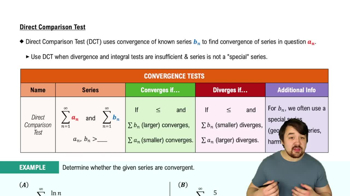
Comparison Test for Series

The Comparison Test involves comparing the given series to a known benchmark series with positive terms. If the given series is smaller than a convergent series or larger than a divergent series, conclusions about its convergence or divergence can be drawn.
Video consigliato:
Percorso guidato
09:25
Direct Comparison Test

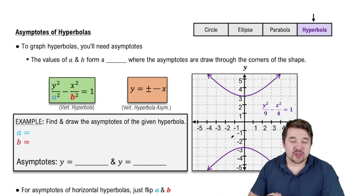
Asymptotic Behavior and Simplification of Terms

Analyzing the behavior of terms for large indices (k → ∞) helps simplify complex expressions. Approximating dominant terms allows us to compare the series to simpler p-series or geometric series, facilitating the application of convergence tests.
Video consigliato:
Percorso guidato
5:50
Asymptotes of Hyperbolas