
Domanda del libro di testo
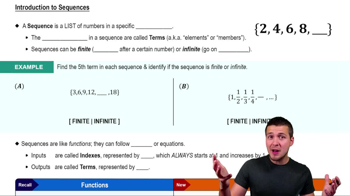
13–20. Explicit formulas Write the first four terms of the sequence { aₙ }∞ₙ₌₁.
aₙ = (2ⁿ⁺¹) / (2ⁿ + 1)
92
views

 Guida verificata passo dopo passo
 8:22
8:22
 4:47 4:47
13–20. Explicit formulas Write the first four terms of the sequence { aₙ }∞ₙ₌₁.
aₙ = (2ⁿ⁺¹) / (2ⁿ + 1)
55–70. More sequences
Find the limit of the following sequences or determine that the sequence diverges.
aₙ = (−1)ⁿ ⁿ√n
13–52. Limits of sequences
Find the limit of the following sequences or determine that the sequence diverges.
{(3ⁿ⁺¹ + 3)⁄3ⁿ}
11–86. Applying convergence tests Determine whether the following series converge. Justify your answers.
∑ (from k = 1 to ∞)(⁵√k) / ⁵√(k⁷ + 1)
55–70. More sequences
Find the limit of the following sequences or determine that the sequence diverges.
{tan⁻¹n / n}
1–10. Choosing convergence tests Identify a convergence test for each series. If necessary, explain how to simplify or rewrite the series before applying the convergence test. You do not need to carry out the convergence test.
∑ (from k = 1 to ∞) (k² / (k⁴ + k³ + 1))