Ch. 10 - Sequences and Infinite Series
Briggs - Calculus: Early Transcendentals 3rd Edition
Briggs3rd EditionCalculus: Early TranscendentalsISBN: 9780136847243Non è quello che usi tu?Cambia libro di testo
Capitolo 10, Problema 10.R.13

12–24. Limits of sequences Evaluate the limit of the sequence or state that it does not exist.
aₙ = (–1)ⁿ (3n³ + 4n) / (6n³ + 5)

Guida verificata passo dopo passo
1
Identify the given sequence: \(a_n = (-1)^n \frac{3n^3 + 4n}{6n^3 + 5}\).
Observe that the sequence has a factor \((-1)^n\) which causes the terms to alternate in sign depending on whether \(n\) is even or odd.
Focus on the rational expression \(\frac{3n^3 + 4n}{6n^3 + 5}\). To analyze its behavior as \(n \to \infty\), divide numerator and denominator by \(n^3\), the highest power of \(n\) in the expression.
After dividing, rewrite the expression as \(\frac{3 + \frac{4}{n^2}}{6 + \frac{5}{n^3}}\). As \(n\) approaches infinity, the terms with \(\frac{1}{n^k}\) approach zero, simplifying the expression to \(\frac{3}{6} = \frac{1}{2}\).
Combine this limit with the alternating factor \((-1)^n\). Since \((-1)^n\) oscillates between \(1\) and \(-1\), the sequence does not approach a single value but oscillates between \(\frac{1}{2}\) and \(-\frac{1}{2}\). Therefore, the limit of the sequence does not exist.

Risposta video verificata per un problema simile:

Questa soluzione video è stata consigliata dai nostri tutor come utile per risolvere questo problema.
Durata del video:
3m

Concetti chiave

Ecco i concetti essenziali che devi comprendere per rispondere correttamente alla domanda.

Limits of Sequences

The limit of a sequence is the value that the terms of the sequence approach as the index n goes to infinity. If the terms get arbitrarily close to a specific number, the sequence converges to that limit; otherwise, it diverges.
Video consigliato:
8:22
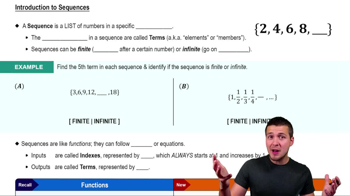
Introduction to Sequences

Behavior of Polynomial Expressions at Infinity

When evaluating limits involving polynomials as n approaches infinity, the highest degree terms dominate the behavior. Lower degree terms become insignificant, so the limit can often be found by comparing the leading coefficients of the highest degree terms.
Video consigliato:
07:00
Taylor Polynomials

Alternating Sequences

An alternating sequence changes sign with each term, often involving factors like (-1)^n. Such sequences may oscillate and not have a limit unless the magnitude of terms approaches zero, causing the sequence to converge to zero.
Video consigliato:
8:22
Introduction to Sequences