Ch. 10 - Sequences and Infinite Series
Briggs - Calculus: Early Transcendentals 3rd Edition
Briggs3rd EditionCalculus: Early TranscendentalsISBN: 9780136847243Non è quello che usi tu?Cambia libro di testo
Capitolo 10, Problema 10.R.63

42–76. Convergence or divergence Use a convergence test of your choice to determine whether the following series converge.
∑ (from k = 1 to ∞)3 / (2 + eᵏ)

Guida verificata passo dopo passo
1
Identify the series given: \( \sum_{k=1}^{\infty} \frac{3}{2 + e^{k}} \). We want to determine if this infinite series converges or diverges.
Observe the general term of the series: \( a_k = \frac{3}{2 + e^{k}} \). Since \( e^{k} \) grows exponentially, the denominator increases very quickly as \( k \) becomes large.
Compare \( a_k \) to a simpler series to test for convergence. Notice that for large \( k \), \( 2 + e^{k} \approx e^{k} \), so \( a_k \approx \frac{3}{e^{k}} \). This suggests comparing to the geometric series \( \sum \frac{3}{e^{k}} \).
Recall that a geometric series \( \sum r^{k} \) converges if \( |r| < 1 \). Here, \( r = \frac{1}{e} \), which is less than 1, so \( \sum \frac{3}{e^{k}} \) converges.
By the Comparison Test, since \( 0 < \frac{3}{2 + e^{k}} < \frac{3}{e^{k}} \) for all \( k \) and \( \sum \frac{3}{e^{k}} \) converges, the original series \( \sum_{k=1}^{\infty} \frac{3}{2 + e^{k}} \) also converges.

Risposta video verificata per un problema simile:

Questa soluzione video è stata consigliata dai nostri tutor come utile per risolvere questo problema.
Durata del video:
4m

Concetti chiave

Ecco i concetti essenziali che devi comprendere per rispondere correttamente alla domanda.

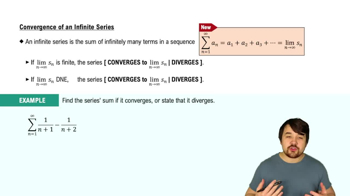
Infinite Series and Convergence

An infinite series is the sum of infinitely many terms. Understanding whether such a series converges (approaches a finite limit) or diverges (grows without bound or oscillates) is fundamental in calculus. Convergence ensures the series has a meaningful sum.
Video consigliato:
Percorso guidato
06:52
Convergence of an Infinite Series

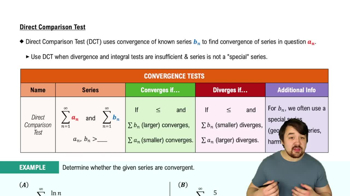
Comparison Test for Series

The Comparison Test determines convergence by comparing the given series to a second series with known behavior. If the terms of the given series are smaller than those of a convergent series, it also converges; if larger than a divergent series, it diverges.
Video consigliato:
Percorso guidato
09:25
Direct Comparison Test

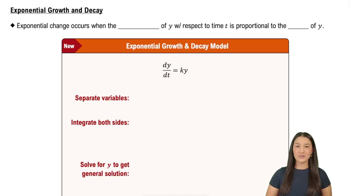
Exponential Growth and Its Impact on Series Terms

Exponential functions like e^k grow very rapidly as k increases. In the series terms 3/(2 + e^k), the denominator grows exponentially, causing terms to approach zero quickly, which is a key factor in assessing convergence.
Video consigliato:
09:29
Exponential Growth & Decay