Ch. 10 - Sequences and Infinite Series
Briggs - Calculus: Early Transcendentals 3rd Edition
Briggs3rd EditionCalculus: Early TranscendentalsISBN: 9780136847243Non è quello che usi tu?Cambia libro di testo
Capitolo 10, Problema 10.3.17

16–17. {Use of Tech} Periodic savings
Suppose you deposit m dollars at the beginning of every month in a savings account that earns a monthly interest rate of r, which is the annual interest rate divided by 12 (for example, if the annual interest rate is 2.4%, r = 0.024/12 = 0.002). For an initial investment of m dollars, the amount of money in your account at the beginning of the second month is the sum of your second deposit and your initial deposit plus interest, or m + m(1 + r). Continuing in this fashion, it can be shown that the amount of money in your account after n months is


Aₙ = m + m(1 + r) + ⋯ + m(1 + r)ⁿ⁻¹.


Use geometric sums to determine the amount of money in your savings account after 5 years (60 months) using the given monthly deposit and interest rate.


17. Monthly deposits of \$250 at a monthly interest rate of 0.2%

Guida verificata passo dopo passo
1
Identify the variables given in the problem: the monthly deposit amount \(m = 250\), the monthly interest rate \(r = 0.002\) (which is 0.2%), and the total number of months \(n = 60\) (5 years).
Recognize that the total amount in the account after \(n\) months is given by the sum of a geometric series: \[A_n = m + m(1 + r) + m(1 + r)^2 + \cdots + m(1 + r)^{n-1}.\]
Factor out \(m\) from the sum to write it as: \[A_n = m \left[1 + (1 + r) + (1 + r)^2 + \cdots + (1 + r)^{n-1}\right].\]
Use the formula for the sum of a geometric series with first term \(a = 1\) and common ratio \(q = 1 + r\): \[\sum_{k=0}^{n-1} q^k = \frac{q^n - 1}{q - 1}.\] Substitute \(q = 1 + r\) to get: \[A_n = m \cdot \frac{(1 + r)^n - 1}{r}.\]
Substitute the known values \(m = 250\), \(r = 0.002\), and \(n = 60\) into the formula to express the amount after 5 years: \[A_{60} = 250 \cdot \frac{(1 + 0.002)^{60} - 1}{0.002}.\] This expression can now be evaluated to find the total amount in the account.

Risposta video verificata per un problema simile:

Questa soluzione video è stata consigliata dai nostri tutor come utile per risolvere questo problema.
Durata del video:
3m

Concetti chiave

Ecco i concetti essenziali che devi comprendere per rispondere correttamente alla domanda.

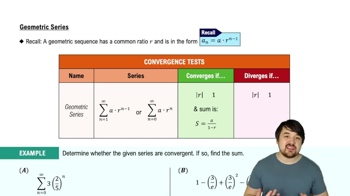
Geometric Series and Sums

A geometric series is a sum of terms where each term is a constant multiple (common ratio) of the previous one. The formula for the sum of the first n terms is Sₙ = a(1 - rⁿ) / (1 - r), where a is the first term and r is the common ratio. This formula helps calculate the total amount accumulated when deposits grow with interest over time.
Video consigliato:
Percorso guidato
06:00
Geometric Series

Compound Interest with Periodic Deposits

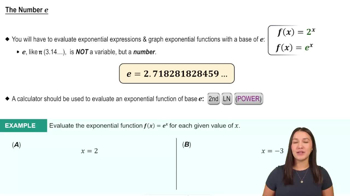
Compound interest means interest is earned on both the initial principal and the accumulated interest from previous periods. When deposits are made periodically, each deposit grows for a different number of periods, requiring summation of multiple compound amounts. Understanding this helps model how monthly deposits accumulate with interest.
Video consigliato:
4:47
The Number e

Converting Annual Interest Rate to Monthly Rate

Interest rates are often given annually but compounding occurs monthly, so the annual rate must be divided by 12 to find the monthly rate. For example, an annual rate of 2.4% becomes 0.002 monthly. This conversion is essential for accurately calculating interest growth in monthly compounding scenarios.
Video consigliato:
Percorso guidato
04:16
Intro To Related Rates