Ch. 10 - Sequences and Infinite Series
Briggs - Calculus: Early Transcendentals 3rd Edition
Briggs3rd EditionCalculus: Early TranscendentalsISBN: 9780136847243Non è quello che usi tu?Cambia libro di testo
Capitolo 10, Problema 10.5.35

9–36. Comparison tests Use the Comparison Test or the Limit Comparison Test to determine whether the following series converge.
{Use of Tech} ∑ (k = 1 to ∞) 1 / (4lnk)

Guida verificata passo dopo passo
1
Identify the given series: \( \sum_{k=1}^{\infty} \frac{1}{4 \ln k} \). Note that the term for \(k=1\) is undefined since \(\ln 1 = 0\), so consider the series starting from \(k=2\) instead.
Recall that the Comparison Test and Limit Comparison Test are used to determine convergence by comparing the given series to a known benchmark series. Since the terms involve \( \frac{1}{\ln k} \), consider comparing it to the harmonic series \( \sum \frac{1}{k} \), which is divergent.
Set up the Limit Comparison Test by defining \(a_k = \frac{1}{4 \ln k} \) and \(b_k = \frac{1}{k} \). Compute the limit \( L = \lim_{k \to \infty} \frac{a_k}{b_k} = \lim_{k \to \infty} \frac{1/(4 \ln k)}{1/k} = \lim_{k \to \infty} \frac{k}{4 \ln k} \).
Analyze the limit \( L = \lim_{k \to \infty} \frac{k}{4 \ln k} \). Since \(k\) grows faster than \(\ln k\), this limit tends to infinity, which means the Limit Comparison Test with \(b_k = \frac{1}{k}\) is inconclusive.
Try a different comparison series, such as \(b_k = \frac{1}{k^p} \) for some \(p > 0\), or consider the integral test for \( \int \frac{1}{\ln x} dx \) to analyze convergence. The integral test can help determine if the series converges or diverges by examining the behavior of the integral of the function \(f(x) = \frac{1}{4 \ln x} \) for \(x \geq 2\).

Risposta video verificata per un problema simile:

Questa soluzione video è stata consigliata dai nostri tutor come utile per risolvere questo problema.
Durata del video:
3m

Concetti chiave

Ecco i concetti essenziali che devi comprendere per rispondere correttamente alla domanda.

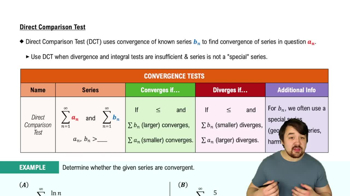
Comparison Test

The Comparison Test determines the convergence or divergence of a series by comparing it to a second series with known behavior. If the terms of the given series are smaller than those of a convergent series, it also converges; if larger than those of a divergent series, it diverges.
Video consigliato:
Percorso guidato
09:25
Direct Comparison Test

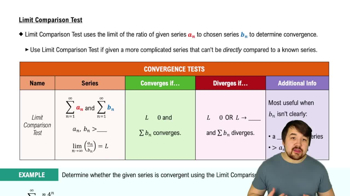
Limit Comparison Test

The Limit Comparison Test compares two series by taking the limit of the ratio of their terms. If this limit is a positive finite number, both series either converge or diverge together, making it useful when direct comparison is difficult.
Video consigliato:
Percorso guidato
07:45
Limit Comparison Test

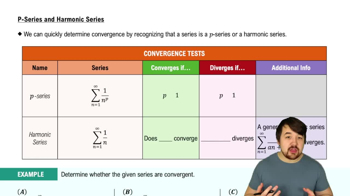
Behavior of the Harmonic Series and Logarithmic Terms

Understanding the divergence of the harmonic series and how logarithmic terms affect convergence is crucial. Since ∑ 1/k diverges, series like ∑ 1/(ln k) require careful comparison, as logarithmic growth is slow and affects the series' convergence properties.
Video consigliato:
Percorso guidato
04:30
P-Series and Harmonic Series
Pratica correlata
Domanda del libro di testo

13–20. Explicit formulas Write the first four terms of the sequence { aₙ }∞ₙ₌₁. 

aₙ = 1/10ⁿ

76
views

Domanda del libro di testo

32–49. Choose your test Use the test of your choice to determine whether the following series converge absolutely, converge conditionally, or diverge.

∑ (from k = 1 to ∞) k¹⁰⁰ / (k + 1)!

47
views
Domanda del libro di testo

9–36. Comparison tests Use the Comparison Test or the Limit Comparison Test to determine whether the following series converge.


∑ (k = 1 to ∞) (2 + (−1)ᵏ) / k²

36
views
Domanda del libro di testo

16–17. {Use of Tech} Periodic savings

Suppose you deposit m dollars at the beginning of every month in a savings account that earns a monthly interest rate of r, which is the annual interest rate divided by 12 (for example, if the annual interest rate is 2.4%, r = 0.024/12 = 0.002). For an initial investment of m dollars, the amount of money in your account at the beginning of the second month is the sum of your second deposit and your initial deposit plus interest, or m + m(1 + r). Continuing in this fashion, it can be shown that the amount of money in your account after n months is


Aₙ = m + m(1 + r) + ⋯ + m(1 + r)ⁿ⁻¹.


Use geometric sums to determine the amount of money in your savings account after 5 years (60 months) using the given monthly deposit and interest rate.


17. Monthly deposits of \$250 at a monthly interest rate of 0.2%

67
views
Domanda del libro di testo

39–44. {Use of Tech} Estimating infinite series Estimate the value of the following convergent series with an absolute error less than 10⁻³.


∑ (k = 1 to ∞) (−1)ᵏ / k⁵

39
views
Domanda del libro di testo

17–22. Integral Test Use the Integral Test to determine whether the following series converge after showing that the conditions of the Integral Test are satisfied.

∑ (k = 1 to ∞) 1 / (∛(5k + 3))

85
views