Ch. 10 - Sequences and Infinite Series
Briggs - Calculus: Early Transcendentals 3rd Edition
Briggs3rd EditionCalculus: Early TranscendentalsISBN: 9780136847243Non è quello che usi tu?Cambia libro di testo
Capitolo 10, Problema 10.7.39

32–49. Choose your test Use the test of your choice to determine whether the following series converge absolutely, converge conditionally, or diverge.
∑ (from k = 1 to ∞) (−1)ᵏ k³ / √(k⁸ + 1)

Guida verificata passo dopo passo
1
Identify the given series: \( \sum_{k=1}^{\infty} (-1)^k \frac{k^3}{\sqrt{k^8 + 1}} \). Notice it is an alternating series because of the factor \( (-1)^k \).
To determine absolute convergence, consider the absolute value of the terms: \( \left| \frac{k^3}{\sqrt{k^8 + 1}} \right| = \frac{k^3}{\sqrt{k^8 + 1}} \). Simplify this expression to understand its behavior as \( k \to \infty \).
Analyze the limit of the absolute value of the terms as \( k \to \infty \). Since \( \sqrt{k^8 + 1} = (k^8 + 1)^{1/2} \), rewrite it as \( k^4 \sqrt{1 + \frac{1}{k^8}} \). Then the term becomes \( \frac{k^3}{k^4 \sqrt{1 + \frac{1}{k^8}}} = \frac{1}{k \sqrt{1 + \frac{1}{k^8}}} \).
Evaluate the limit \( \lim_{k \to \infty} \frac{1}{k \sqrt{1 + \frac{1}{k^8}}} \). Since \( \sqrt{1 + \frac{1}{k^8}} \to 1 \), the limit behaves like \( \frac{1}{k} \), which goes to zero.
Since the terms behave like \( \frac{1}{k} \) for large \( k \), the absolute series resembles the harmonic series \( \sum \frac{1}{k} \), which diverges. Therefore, the series does not converge absolutely. Next, apply the Alternating Series Test by checking if the terms \( b_k = \frac{k^3}{\sqrt{k^8 + 1}} \) decrease monotonically to zero to determine conditional convergence.

Risposta video verificata per un problema simile:

Questa soluzione video è stata consigliata dai nostri tutor come utile per risolvere questo problema.
Durata del video:
7m

Concetti chiave

Ecco i concetti essenziali che devi comprendere per rispondere correttamente alla domanda.

Absolute and Conditional Convergence

Absolute convergence occurs when the series of absolute values converges, ensuring the original series converges regardless of term signs. Conditional convergence happens when the series converges but not absolutely, often due to alternating signs. Understanding these distinctions helps classify the behavior of infinite series.
Video consigliato:
Percorso guidato
07:51
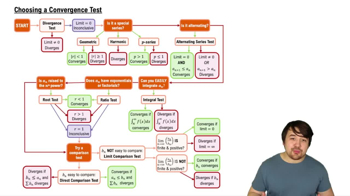
Choosing a Convergence Test

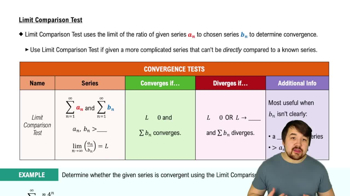
Limit Comparison Test

The Limit Comparison Test compares a given series to a known benchmark series by examining the limit of their term ratios. If the limit is a positive finite number, both series share the same convergence behavior. This test is useful for series with complicated terms involving polynomials and roots.
Video consigliato:
Percorso guidato
07:45
Limit Comparison Test

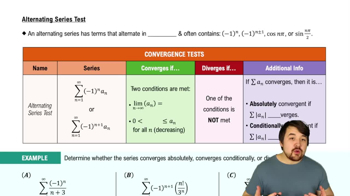
Alternating Series Test

The Alternating Series Test determines convergence of series whose terms alternate in sign. It requires that the absolute value of terms decreases monotonically to zero. If these conditions hold, the series converges, which helps identify conditional convergence in alternating series.
Video consigliato:
Percorso guidato
10:54
Alternating Series Test