Ch. 10 - Sequences and Infinite Series
Briggs - Calculus: Early Transcendentals 3rd Edition
Briggs3rd EditionCalculus: Early TranscendentalsISBN: 9780136847243Non è quello che usi tu?Cambia libro di testo
Capitolo 10, Problema 10.2.5

For what values of r does the sequence {rⁿ} converge? Diverge?

Guida verificata passo dopo passo
1
Recall that the sequence is given by \(a_n = r^n\), where \(n\) is a natural number and \(r\) is a real number parameter.
To determine convergence or divergence, analyze the behavior of \(r^n\) as \(n\) approaches infinity for different values of \(r\).
Consider the cases based on the absolute value of \(r\): - If \(|r| < 1\), then \(r^n\) approaches 0 as \(n \to \infty\), so the sequence converges to 0. - If \(|r| = 1\), then: * If \(r = 1\), the sequence is constant and converges to 1. * If \(r = -1\), the sequence oscillates between 1 and -1 and does not converge. - If \(|r| > 1\), then \(r^n\) grows without bound in magnitude, so the sequence diverges.
Summarize the results: - Converges to 0 if \(|r| < 1\). - Converges to 1 if \(r = 1\). - Diverges if \(|r| > 1\) or if \(r = -1\) (due to oscillation).
Therefore, the key step is to analyze the absolute value of \(r\) and apply the limit definition of convergence for sequences.

Risposta video verificata per un problema simile:

Questa soluzione video è stata consigliata dai nostri tutor come utile per risolvere questo problema.
Durata del video:
3m

Concetti chiave

Ecco i concetti essenziali che devi comprendere per rispondere correttamente alla domanda.

Definition of Sequence Convergence

A sequence converges if its terms approach a specific finite limit as n approaches infinity. For the sequence {rⁿ}, this means finding values of r for which rⁿ approaches a finite number when n becomes very large.
Video consigliato:
8:22
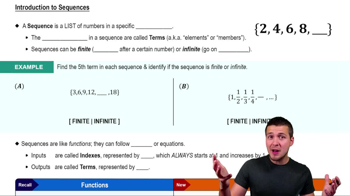
Introduction to Sequences

Behavior of Exponential Sequences

The sequence {rⁿ} is exponential, where each term is r raised to the power n. Its behavior depends on the magnitude of r: if |r| < 1, the terms get smaller and approach zero; if |r| > 1, the terms grow without bound; if |r| = 1, the sequence may oscillate or remain constant.
Video consigliato:
8:22
Introduction to Sequences

Limits Involving Absolute Value

The absolute value of r determines the limit of rⁿ as n approaches infinity. When |r| < 1, rⁿ tends to zero, ensuring convergence. When |r| > 1, rⁿ diverges to infinity or negative infinity. When |r| = 1, the sequence either stays constant (r=1) or oscillates (r=-1), affecting convergence.
Video consigliato:
07:01
Integrals Involving Natural Logs: Substitution