
Ch. 10 - Sequences and Infinite Series
Briggs - Calculus: Early Transcendentals 3rd Edition
Briggs3rd EditionCalculus: Early TranscendentalsISBN: 9780136847243Non è quello che usi tu?Cambia libro di testo
Capitolo 10, Problema 10.4.41a

41–44. {Use of Tech} Remainders and estimates Consider the following convergent series.


a. Find an upper bound for the remainder in terms of n.


41. ∑ (k = 1 to ∞) 1 / k⁶

Guida verificata passo dopo passo
1
Recognize that the series \( \sum_{k=1}^{\infty} \frac{1}{k^6} \) is a convergent p-series with \( p = 6 > 1 \), which ensures convergence.
To find an upper bound for the remainder \( R_n = \sum_{k=n+1}^{\infty} \frac{1}{k^6} \), use the integral test remainder estimate, which states that \( R_n \leq \int_{n}^{\infty} \frac{1}{x^6} \, dx \).
Set up the improper integral \( \int_{n}^{\infty} x^{-6} \, dx \) to estimate the remainder.
Evaluate the integral: \( \int_{n}^{\infty} x^{-6} \, dx = \lim_{t \to \infty} \int_{n}^{t} x^{-6} \, dx \).
Compute the antiderivative of \( x^{-6} \), which is \( \frac{x^{-5}}{-5} \), then apply the limits from \( n \) to \( \infty \) to express the upper bound for the remainder \( R_n \).

Risposta video verificata per un problema simile:

Questa soluzione video è stata consigliata dai nostri tutor come utile per risolvere questo problema.
Durata del video:
2m

Concetti chiave

Ecco i concetti essenziali che devi comprendere per rispondere correttamente alla domanda.

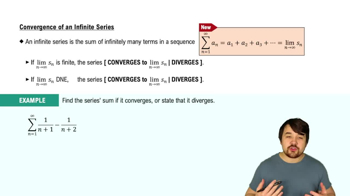
Convergence of Infinite Series

An infinite series converges if the sum of its terms approaches a finite limit as the number of terms increases. For series like ∑ 1/k⁶, which is a p-series with p > 1, convergence is guaranteed. Understanding convergence is essential to discuss remainders and error bounds.
Video consigliato:
Percorso guidato
06:52
Convergence of an Infinite Series

Remainder (Error) in Partial Sums

The remainder after n terms of a convergent series is the difference between the infinite sum and the partial sum up to n. Estimating this remainder helps determine how close the partial sum is to the actual sum, which is crucial for approximations and error analysis.
Video consigliato:
Percorso guidato
08:01
Integration Using Partial Fractions

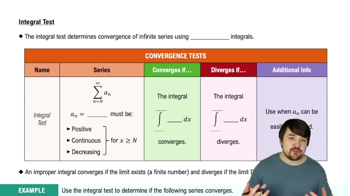
Integral Test and Remainder Estimation

The integral test can be used to estimate the remainder of a decreasing positive term series by comparing the tail of the series to an improper integral. This provides an upper bound for the remainder, making it a practical tool for bounding errors in series approximations.
Video consigliato:
Pratica correlata
Domanda del libro di testo

{Use of Tech} A savings plan

James begins a savings plan in which he deposits \$100 at the beginning of each month into an account that earns 9% interest annually, or equivalently, 0.75% per month.

To be clear, on the first day of each month, the bank adds 0.75% of the current balance as interest, and then James deposits \$100.


Let Bₙ be the balance in the account after the nᵗʰ payment, where B₀ = \$0.


a.Write the first five terms of the sequence {Bₙ}.

57
views
Domanda del libro di testo

88–89. Binary numbers

Humans use the ten digits 0 through 9 to form base-10 or decimal numbers, whereas computers calculate and store numbers internally as binary numbers—numbers consisting entirely of 0’s and 1’s. For this exercise, we consider binary numbers that have the form 0.b₁b₂b₃⋯, where each of the digits b₁, b₂, b₃, ⋯ is either 0 or 1. The base-10 representation of the binary number 0.b₁b₂b₃⋯ is the infinite series

b₁ / 2¹ + b₂ / 2² + b₃ / 2³ + ⋯


89. Computers can store only a finite number of digits and therefore numbers with nonterminating digits must be rounded or truncated before they can be used and stored by a computer.


a. Find the base-10 representation of the binary number 0.001̅1.

70
views
Domanda del libro di testo

Explain why or why not

Determine whether the following statements are true and give an explanation or counterexample.

a.If limₙ→∞aₙ = 1 and limₙ→∞bₙ = 3, then limₙ→∞(bₙ / aₙ) = 3.

48
views
Domanda del libro di testo

27–34. Working with sequences Several terms of a sequence {aₙ}ₙ₌₁∞ are given.

a. Find the next two terms of the sequence.

{-5, 5, -5, 5, ......}

47
views
Domanda del libro di testo

27–37. Evaluating series Evaluate the following infinite series or state that the series diverges.

∑ (from k = 0 to ∞)((1/3)ᵏ + (4/3)ᵏ)

51
views
Domanda del libro di testo

Loglog p-series Consider the series ∑ (k = 2 to ∞) 1 / (k(ln k)(ln ln k)ᵖ), where p is a real number.

a. For what values of p does this series converge?

52
views