
Ch. 10 - Sequences and Infinite Series
Briggs - Calculus: Early Transcendentals 3rd Edition
Briggs3rd EditionCalculus: Early TranscendentalsISBN: 9780136847243Non è quello che usi tu?Cambia libro di testo
Capitolo 10, Problema 10.2.73a

{Use of Tech} A savings plan
James begins a savings plan in which he deposits \$100 at the beginning of each month into an account that earns 9% interest annually, or equivalently, 0.75% per month.
To be clear, on the first day of each month, the bank adds 0.75% of the current balance as interest, and then James deposits \$100.


Let Bₙ be the balance in the account after the nᵗʰ payment, where B₀ = \$0.


a.Write the first five terms of the sequence {Bₙ}.

Guida verificata passo dopo passo
1
Understand the problem setup: James deposits \$100 at the beginning of each month, and the account earns 0.75% interest monthly. The interest is added first, then the deposit is made each month.
Define the sequence {Bₙ} where B₀ = 0 represents the balance before any deposits or interest. For each month n, the balance after the nth deposit is Bₙ.
Express the recursive formula for Bₙ: The balance after the nth payment is the previous balance Bₙ₋₁ grown by 0.75% interest, plus the new \$100 deposit. Mathematically, this is: \(B_{n} = B_{n-1} \times (1 + 0.0075) + 100\)
Calculate the first five terms step-by-step using the recursive formula: - \(B_0 = 0\) - \(B_1 = B_0 \times 1.0075 + 100\) - \(B_2 = B_1 \times 1.0075 + 100\) - \(B_3 = B_2 \times 1.0075 + 100\) - \(B_4 = B_3 \times 1.0075 + 100\) - \(B_5 = B_4 \times 1.0075 + 100\)
Write out each term explicitly by substituting the previous term's value, showing how the balance grows month by month with interest and deposits.

Risposta video verificata per un problema simile:

Questa soluzione video è stata consigliata dai nostri tutor come utile per risolvere questo problema.
Durata del video:
6m

Concetti chiave

Ecco i concetti essenziali che devi comprendere per rispondere correttamente alla domanda.

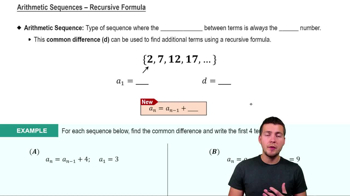
Recursive Sequences

A recursive sequence defines each term based on the previous term(s). In this problem, the balance after each payment depends on the previous balance plus interest and the new deposit. Understanding how to express Bₙ in terms of Bₙ₋₁ is essential to write out the sequence terms.
Video consigliato:
6:40
Arithmetic Sequences - Recursive Formula

Compound Interest

Compound interest means interest is earned on both the initial principal and the accumulated interest from previous periods. Here, interest is added monthly at 0.75%, so the balance grows by multiplying the previous balance by 1.0075 before adding the new deposit.
Video consigliato:
4:47
The Number e

Sequence Initialization and Notation

The sequence starts with B₀ = 0, representing the initial balance before any deposits. Correctly interpreting the timing of interest addition and deposits is crucial to accurately calculate each term Bₙ, especially since interest is added before the deposit each month.
Video consigliato:
8:22
Introduction to Sequences
Pratica correlata
Domanda del libro di testo

88–89. Binary numbers

Humans use the ten digits 0 through 9 to form base-10 or decimal numbers, whereas computers calculate and store numbers internally as binary numbers—numbers consisting entirely of 0’s and 1’s. For this exercise, we consider binary numbers that have the form 0.b₁b₂b₃⋯, where each of the digits b₁, b₂, b₃, ⋯ is either 0 or 1. The base-10 representation of the binary number 0.b₁b₂b₃⋯ is the infinite series

b₁ / 2¹ + b₂ / 2² + b₃ / 2³ + ⋯


89. Computers can store only a finite number of digits and therefore numbers with nonterminating digits must be rounded or truncated before they can be used and stored by a computer.


a. Find the base-10 representation of the binary number 0.001̅1.

70
views
Domanda del libro di testo

Explain why or why not

Determine whether the following statements are true and give an explanation or counterexample.

a.If limₙ→∞aₙ = 1 and limₙ→∞bₙ = 3, then limₙ→∞(bₙ / aₙ) = 3.

48
views
Domanda del libro di testo

27–37. Evaluating series Evaluate the following infinite series or state that the series diverges.

∑ (from k = 0 to ∞)((1/3)ᵏ + (4/3)ᵏ)

51
views
Domanda del libro di testo

41–44. {Use of Tech} Remainders and estimates Consider the following convergent series.


a. Find an upper bound for the remainder in terms of n.


41. ∑ (k = 1 to ∞) 1 / k⁶

105
views
Domanda del libro di testo

Loglog p-series Consider the series ∑ (k = 2 to ∞) 1 / (k(ln k)(ln ln k)ᵖ), where p is a real number.

a. For what values of p does this series converge?

52
views
Domanda del libro di testo

89–90. {Use of Tech} Lower and upper bounds of a series

For each convergent series and given value of n, complete the following.


c. Find lower and upper bounds (Lₙ and Uₙ respectively) for the exact value of the series.


89.∑ (from k = 1 to ∞)1 / k⁵ ;n = 5

104
views