Ch. 10 - Sequences and Infinite Series
Briggs - Calculus: Early Transcendentals 3rd Edition
Briggs3rd EditionCalculus: Early TranscendentalsISBN: 9780136847243Non è quello che usi tu?Cambia libro di testo
Capitolo 10, Problema 10.R.59

42–76. Convergence or divergence Use a convergence test of your choice to determine whether the following series converge.
∑ (from j = 0 to ∞)2 ⋅ 4ʲ / (2j + 1)!

Guida verificata passo dopo passo
1
Identify the given series: \( \sum_{j=0}^{\infty} \frac{2 \cdot 4^{j}}{(2j + 1)!} \). We want to determine if this infinite series converges or diverges.
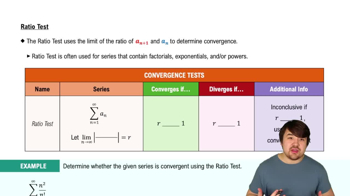
Consider using the Ratio Test, which is often effective for series involving factorials and exponential terms. The Ratio Test states that for \( a_j \), if \( L = \lim_{j \to \infty} \left| \frac{a_{j+1}}{a_j} \right| \), then the series converges if \( L < 1 \), diverges if \( L > 1 \), and is inconclusive if \( L = 1 \).
Write the general term \( a_j = \frac{2 \cdot 4^{j}}{(2j + 1)!} \) and the next term \( a_{j+1} = \frac{2 \cdot 4^{j+1}}{(2(j+1) + 1)!} = \frac{2 \cdot 4^{j+1}}{(2j + 3)!} \).
Form the ratio \( \left| \frac{a_{j+1}}{a_j} \right| = \frac{2 \cdot 4^{j+1}}{(2j + 3)!} \times \frac{(2j + 1)!}{2 \cdot 4^{j}} = \frac{4 \cdot (2j + 1)!}{(2j + 3)!} \). Simplify the factorial expression to express the ratio in terms of \( j \).
Evaluate the limit \( L = \lim_{j \to \infty} \left| \frac{a_{j+1}}{a_j} \right| \) using the simplified expression. Based on the value of \( L \), conclude whether the series converges or diverges according to the Ratio Test.

Risposta video verificata per un problema simile:

Questa soluzione video è stata consigliata dai nostri tutor come utile per risolvere questo problema.
Durata del video:
4m

Concetti chiave

Ecco i concetti essenziali che devi comprendere per rispondere correttamente alla domanda.

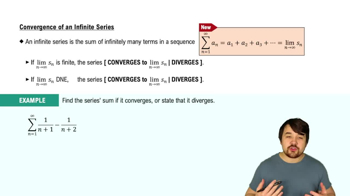
Infinite Series and Convergence

An infinite series is the sum of infinitely many terms. Determining whether a series converges means checking if the sum approaches a finite limit as the number of terms grows indefinitely. Understanding convergence is essential to analyze the behavior of series like the one given.
Video consigliato:
Percorso guidato
06:52
Convergence of an Infinite Series

Ratio Test

The Ratio Test is a common method to determine the convergence of series with factorials or exponential terms. It involves taking the limit of the absolute value of the ratio of consecutive terms. If this limit is less than one, the series converges absolutely.
Video consigliato:

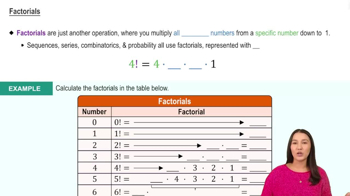
Factorials and Growth Rates

Factorials (n!) grow faster than exponential functions as n increases. Recognizing how factorials dominate growth helps in applying convergence tests effectively, especially when terms include factorials in the denominator, often leading to convergence.
Video consigliato:
5:22
Factorials
Pratica correlata
Domanda del libro di testo

42–76. Convergence or divergence Use a convergence test of your choice to determine whether the following series converge.

∑ (from k = 1 to ∞)(1 − cos(1 / k))²

61
views

Domanda del libro di testo

42–76. Convergence or divergence Use a convergence test of your choice to determine whether the following series converge.

∑ (from k = 1 to ∞)tanh(k)

76
views
Domanda del libro di testo

Explain why or why not

Determine whether the following statements are true and give an explanation or counterexample.


g.The series ∑ (from k = 1 to ∞) (k² / (k² + 1)) converges.

39
views
Domanda del libro di testo

77–87. Absolute or conditional convergence

Determine whether the following series converge absolutely, converge conditionally, or diverge.

∑ (from k = 1 to ∞)(−2)ᵏ⁺¹ / k²

60
views
Domanda del libro di testo

Determine whether the following statements are true and give an explanation or counterexample.

c. The terms of the sequence of partial sums of the series ∑ aₖ approach 5/2, so the infinite series converges to 5/2.

40
views
Domanda del libro di testo

Building a tunnel — first scenario

A crew of workers is constructing a tunnel through a mountain. Understandably, the rate of construction decreases because rocks and earth must be removed a greater distance as the tunnel gets longer. Suppose each week the crew digs 0.95 of the distance it dug the previous week. In the first week, the crew constructed 100 m of tunnel.


b.What is the longest tunnel the crew can build at this rate?

41
views