
Domanda del libro di testo
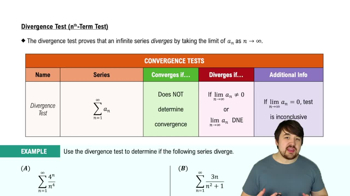
42–76. Convergence or divergence Use a convergence test of your choice to determine whether the following series converge.
∑ (from k = 1 to ∞)tanh(k)
76
views

 Guida verificata passo dopo passo
 06:52
06:52
 05:44
05:44 06:11
06:1142–76. Convergence or divergence Use a convergence test of your choice to determine whether the following series converge.
∑ (from k = 1 to ∞)tanh(k)
77–87. Absolute or conditional convergence
Determine whether the following series converge absolutely, converge conditionally, or diverge.
∑ (from k = 1 to ∞)(−1)ᵏk·e⁻ᵏ
77–87. Absolute or conditional convergence
Determine whether the following series converge absolutely, converge conditionally, or diverge.
∑ (from k = 1 to ∞)(−2)ᵏ⁺¹ / k²
b.Does the series ∑ (from k = 1 to ∞) k/(k + 1) converge? Why or why not?
42–76. Convergence or divergence Use a convergence test of your choice to determine whether the following series converge.
∑ (from j = 0 to ∞)2 ⋅ 4ʲ / (2j + 1)!
Building a tunnel — first scenario
A crew of workers is constructing a tunnel through a mountain. Understandably, the rate of construction decreases because rocks and earth must be removed a greater distance as the tunnel gets longer. Suppose each week the crew digs 0.95 of the distance it dug the previous week. In the first week, the crew constructed 100 m of tunnel.
b.What is the longest tunnel the crew can build at this rate?