Ch. 10 - Sequences and Infinite Series
Briggs - Calculus: Early Transcendentals 3rd Edition
Briggs3rd EditionCalculus: Early TranscendentalsISBN: 9780136847243Non è quello che usi tu?Cambia libro di testo
Capitolo 10, Problema 10.4.51

48–63. Choose your test Determine whether the following series converge or diverge using the properties and tests introduced in Sections 10.3 and 10.4.
∑ (k = 1 to ∞) 1 / ( (3k + 1)(3k + 4) )

Guida verificata passo dopo passo
1
First, recognize the series given: \( \sum_{k=1}^{\infty} \frac{1}{(3k + 1)(3k + 4)} \). This is an infinite series with positive terms, so we can consider tests for convergence of positive term series.
Next, try to simplify the general term using partial fraction decomposition. Express \( \frac{1}{(3k + 1)(3k + 4)} \) as \( \frac{A}{3k + 1} + \frac{B}{3k + 4} \) and solve for constants \( A \) and \( B \).
After finding \( A \) and \( B \), rewrite the series as \( \sum_{k=1}^{\infty} \left( \frac{A}{3k + 1} + \frac{B}{3k + 4} \right) \). This often leads to a telescoping series where many terms cancel out.
Identify the telescoping pattern by writing out the first few terms explicitly and observe how terms cancel when summed.
Finally, use the telescoping property to find the partial sums and analyze their limit as \( n \to \infty \). If the limit exists and is finite, the series converges; otherwise, it diverges.

Risposta video verificata per un problema simile:

Questa soluzione video è stata consigliata dai nostri tutor come utile per risolvere questo problema.
Durata del video:
7m

Concetti chiave

Ecco i concetti essenziali che devi comprendere per rispondere correttamente alla domanda.

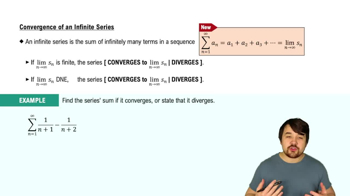
Convergence and Divergence of Infinite Series

An infinite series converges if the sum of its terms approaches a finite limit as the number of terms grows indefinitely. Otherwise, it diverges. Understanding this concept is fundamental to analyzing whether a given series sums to a finite value or not.
Video consigliato:
Percorso guidato
06:52
Convergence of an Infinite Series

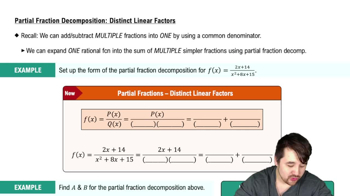
Partial Fraction Decomposition

Partial fraction decomposition breaks a complex rational expression into simpler fractions that are easier to sum or analyze. For series with terms like 1/((3k+1)(3k+4)), this technique helps rewrite terms to identify telescoping behavior or apply known convergence tests.
Video consigliato:
Percorso guidato
10:07
Partial Fraction Decomposition: Distinct Linear Factors

Telescoping Series Test

A telescoping series is one where many terms cancel out when the partial sums are expanded, simplifying the limit evaluation. Recognizing telescoping patterns after decomposition allows for straightforward determination of convergence by examining the remaining terms.
Video consigliato:
Percorso guidato
10:54
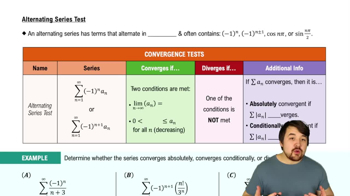
Alternating Series Test