Ch. 10 - Sequences and Infinite Series
Briggs - Calculus: Early Transcendentals 3rd Edition
Briggs3rd EditionCalculus: Early TranscendentalsISBN: 9780136847243Non è quello che usi tu?Cambia libro di testo
Capitolo 10, Problema 10.3.67

54–69. Telescoping series
For the following telescoping series, find a formula for the nth term of the sequence of partial sums {Sₙ}. Then evaluate limₙ→∞ Sₙ to obtain the value of the series or state that the series diverges.


67. ∑ (k = 1 to ∞) 3 / (k² + 5k + 4)

Guida verificata passo dopo passo
1
Start by factoring the denominator of the general term in the series. The denominator is \(k^2 + 5k + 4\). Factor it as \((k + 1)(k + 4)\).
Rewrite the general term \(\frac{3}{k^2 + 5k + 4}\) as \(\frac{3}{(k + 1)(k + 4)}\). Next, use partial fraction decomposition to express this as \(\frac{A}{k + 1} + \frac{B}{k + 4}\) for constants \(A\) and \(B\).
Set up the equation \(\frac{3}{(k + 1)(k + 4)} = \frac{A}{k + 1} + \frac{B}{k + 4}\). Multiply both sides by \((k + 1)(k + 4)\) to get \(3 = A(k + 4) + B(k + 1)\). Solve for \(A\) and \(B\) by choosing convenient values for \(k\) or by equating coefficients.
Once you find \(A\) and \(B\), write the nth partial sum \(S_n = \sum_{k=1}^n \frac{3}{(k + 1)(k + 4)} = \sum_{k=1}^n \left( \frac{A}{k + 1} + \frac{B}{k + 4} \right)\). Separate the sums and write out the terms to identify the telescoping pattern.
Use the telescoping property to cancel terms and find a simplified expression for \(S_n\). Then, evaluate \(\lim_{n \to \infty} S_n\) by analyzing the behavior of the remaining terms as \(n\) approaches infinity to determine if the series converges or diverges.

Risposta video verificata per un problema simile:

Questa soluzione video è stata consigliata dai nostri tutor come utile per risolvere questo problema.
Durata del video:
8m

Concetti chiave

Ecco i concetti essenziali che devi comprendere per rispondere correttamente alla domanda.

Telescoping Series

A telescoping series is a series whose partial sums simplify by canceling intermediate terms, leaving only a few terms from the beginning and end. This simplification makes it easier to find a formula for the nth partial sum and evaluate the series' limit.
Video consigliato:
Percorso guidato
06:00
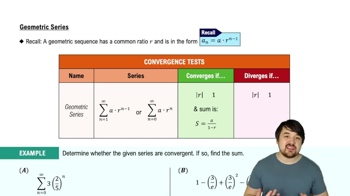
Geometric Series

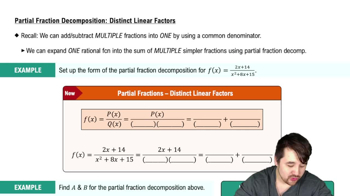
Partial Fraction Decomposition

Partial fraction decomposition breaks a rational function into simpler fractions that are easier to sum or integrate. For series like ∑ 3/(k² + 5k + 4), factoring the denominator and decomposing helps express terms in a telescoping form.
Video consigliato:
Percorso guidato
10:07
Partial Fraction Decomposition: Distinct Linear Factors

Limit of Partial Sums and Convergence

The limit of the sequence of partial sums determines whether an infinite series converges or diverges. If the limit exists and is finite, the series converges to that value; otherwise, it diverges.
Video consigliato:
Percorso guidato
08:01
Integration Using Partial Fractions