Ch. 10 - Sequences and Infinite Series
Briggs - Calculus: Early Transcendentals 3rd Edition
Briggs3rd EditionCalculus: Early TranscendentalsISBN: 9780136847243Non è quello che usi tu?Cambia libro di testo
Capitolo 10, Problema 10.5.11

9–36. Comparison tests Use the Comparison Test or the Limit Comparison Test to determine whether the following series converge.


∑ (k = 1 to ∞) (k² − 1) / (k³ + 4)

Guida verificata passo dopo passo
1
Identify the given series: \( \sum_{k=1}^{\infty} \frac{k^{2} - 1}{k^{3} + 4} \). We want to determine if this series converges or diverges.
Analyze the behavior of the general term \( a_k = \frac{k^{2} - 1}{k^{3} + 4} \) for large \( k \). For large \( k \), the dominant terms in numerator and denominator are \( k^{2} \) and \( k^{3} \), respectively, so \( a_k \) behaves like \( \frac{k^{2}}{k^{3}} = \frac{1}{k} \).
Choose a comparison series that is simpler but has similar behavior for large \( k \). Since \( a_k \) behaves like \( \frac{1}{k} \), consider the harmonic series \( \sum_{k=1}^{\infty} \frac{1}{k} \), which is known to diverge.
Apply the Limit Comparison Test by computing the limit \( L = \lim_{k \to \infty} \frac{a_k}{b_k} = \lim_{k \to \infty} \frac{\frac{k^{2} - 1}{k^{3} + 4}}{\frac{1}{k}} = \lim_{k \to \infty} \frac{(k^{2} - 1) \cdot k}{k^{3} + 4} \). Simplify this expression to find \( L \).
Interpret the result of the limit \( L \). If \( L \) is a finite positive number, then both series either converge or diverge together. Since the harmonic series diverges, this will tell us about the convergence of the original series.

Risposta video verificata per un problema simile:

Questa soluzione video è stata consigliata dai nostri tutor come utile per risolvere questo problema.
Durata del video:
3m

Concetti chiave

Ecco i concetti essenziali che devi comprendere per rispondere correttamente alla domanda.

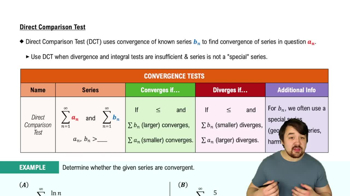
Comparison Test

The Comparison Test determines the convergence of a series by comparing it to a second series with known behavior. If the terms of the given series are smaller than those of a convergent series, it also converges. Conversely, if the terms are larger than those of a divergent series, it diverges.
Video consigliato:
Percorso guidato
09:25
Direct Comparison Test

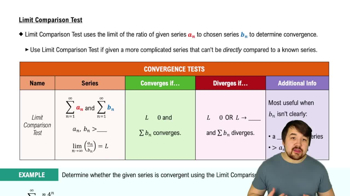
Limit Comparison Test

The Limit Comparison Test compares two series by taking the limit of the ratio of their terms. If this limit is a positive finite number, both series either converge or diverge together. This test is useful when direct comparison is difficult but the terms behave similarly for large indices.
Video consigliato:
Percorso guidato
07:45
Limit Comparison Test

Behavior of Rational Functions in Series

When analyzing series with rational function terms, focus on the highest degree terms in numerator and denominator to determine the dominant behavior as k approaches infinity. This helps identify a simpler comparison series, often a p-series or geometric series, to apply convergence tests effectively.
Video consigliato:
Percorso guidato
06:00
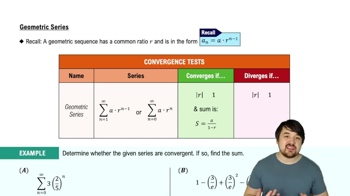
Geometric Series
Pratica correlata
Domanda del libro di testo

Suppose the sequence { aₙ} is defined by the explicit formula aₙ = 1/n, for n=1, 2, 3, .....Write out the first five terms of the sequence.

58
views

Domanda del libro di testo

11–86. Applying convergence tests Determine whether the following series converge. Justify your answers.


∑ (from k = 1 to ∞)(cos(1 / k) – cos(1 / (k + 1)))

38
views
Domanda del libro di testo

43–44. Periodic doses

Suppose you take a dose of m mg of a particular medication once per day. Assume f equals the fraction of the medication that remains in your blood one day later. Just after taking another dose of medication on the second day, the amount of medication in your blood equals the sum of the second dose and the fraction of the first dose remaining in your blood, which is m + mf. Continuing in this fashion, the amount of medication in your blood just after your nth dose is


Aₙ = m + mf + ⋯ + mfⁿ⁻¹.


For the given values of f and m, calculate A₅, A₁₀, A₃₀, and lim (n → ∞) Aₙ. Interpret the meaning of the limit lim (n → ∞) Aₙ.


43.f = 0.25,m = 200 mg

47
views
Domanda del libro di testo

72–86. Evaluating series Evaluate each series or state that it diverges.

∑ (k = 1 to ∞) ((1/3) × (5/6)ᵏ + (3/5) × (7/9)ᵏ)

53
views
Domanda del libro di testo

9–36. Comparison tests Use the Comparison Test or the Limit Comparison Test to determine whether the following series converge.


∑ (k = 1 to ∞) 1 / (2k − √k)

81
views
Domanda del libro di testo

9–30. The Ratio and Root Tests Use the Ratio Test or the Root Test to determine whether the following series converge absolutely or diverge.

∑ (from k = 1 to ∞) ((-1)ᵏ⁺¹ × k²ᵏ) / (k! × k!)

58
views