Ch. 10 - Sequences and Infinite Series
Briggs - Calculus: Early Transcendentals 3rd Edition
Briggs3rd EditionCalculus: Early TranscendentalsISBN: 9780136847243Non è quello che usi tu?Cambia libro di testo
Capitolo 10, Problema 10.2.73c

{Use of Tech} A savings plan
James begins a savings plan in which he deposits \$100 at the beginning of each month into an account that earns 9% interest annually, or equivalently, 0.75% per month.
To be clear, on the first day of each month, the bank adds 0.75% of the current balance as interest, and then James deposits \$100.


Let Bₙ be the balance in the account after the nᵗʰ payment, where B₀ = \$0.


c.How many months are needed to reach a balance of \$5000?

Guida verificata passo dopo passo
1
Recognize that the balance after the nᵗʰ payment, \(B_n\), follows a recurrence relation because each month the bank first adds interest to the current balance, then James deposits \$100.
Express the recurrence relation as: \[B_n = B_{n-1} \times (1 + 0.0075) + 100,\] where \(0.0075\) is the monthly interest rate (0.75%).
Identify that this is a non-homogeneous linear recurrence relation, which can be solved using the formula for the sum of a geometric series or by recognizing it as a future value of an annuity with monthly compounding.
Write the explicit formula for \(B_n\) after \(n\) months: \[B_n = 100 \times \frac{(1 + 0.0075)^n - 1}{0.0075}.\] This formula comes from summing the compounded deposits over \(n\) months.
Set \(B_n = 5000\) and solve for \(n\): \[5000 = 100 \times \frac{(1 + 0.0075)^n - 1}{0.0075}.\] Rearrange to isolate \((1 + 0.0075)^n\) and then take the natural logarithm to solve for \(n\).

Risposta video verificata per un problema simile:

Questa soluzione video è stata consigliata dai nostri tutor come utile per risolvere questo problema.
Durata del video:
5m

Concetti chiave

Ecco i concetti essenziali che devi comprendere per rispondere correttamente alla domanda.

Compound Interest with Periodic Deposits

Compound interest means interest is earned on both the initial principal and the accumulated interest from previous periods. When regular deposits are made, each deposit grows with interest over time, creating a series of compounded amounts. Understanding how interest is applied before or after deposits is crucial for accurate calculations.
Video consigliato:
4:47
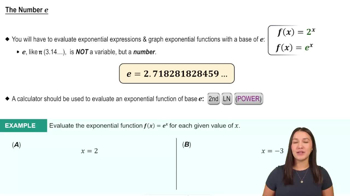
The Number e

Recurrence Relation for Account Balance

The balance after each month can be expressed using a recurrence relation: the new balance equals the previous balance plus interest, then plus the new deposit. This relation helps model the growth of the account step-by-step and is essential for finding the balance after n months or determining n for a target balance.
Video consigliato:
Percorso guidato
04:16
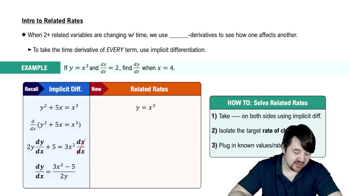
Intro To Related Rates

Solving for Number of Periods in Annuity Problems

To find how many months are needed to reach a target balance, one uses formulas for the future value of an annuity with compound interest. This involves solving for the number of periods n in the equation that relates periodic deposits, interest rate, and final balance, often requiring logarithms or iterative methods.
Video consigliato:
Percorso guidato
05:03
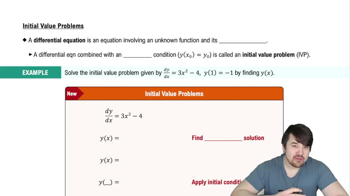
Initial Value Problems
Pratica correlata
Domanda del libro di testo

67–70. Formulas for sequences of partial sums Consider the following infinite series.


c.Make a conjecture for the value of the series.


∑⁽∞⁾ₖ₌₁2⁄[(2k − 1)(2k + 1)]

92
views

Domanda del libro di testo

Explain why or why not

Determine whether the following statements are true and give an explanation or counterexample.


c.The convergent sequences {aₙ} and {bₙ} differ in their first 100 terms, but aₙ = bₙ for n > 100.

It follows that limₙ→∞aₙ = limₙ→∞bₙ.

58
views
Domanda del libro di testo

Explain why or why not Determine whether the following statements are true and give an explanation or counterexample.


c. If lim (as k → ∞) ᵏ√|aₖ| = 1/4, then ∑ 10aₖ converges absolutely.

61
views
Domanda del libro di testo

{Use of Tech} Periodic dosing

Many people take aspirin on a regular basis as a preventive measure for heart disease. Suppose a person takes 80 mg of aspirin every 24 hours. Assume aspirin has a half-life of 24 hours; that is, every 24 hours, half of the drug in the blood is eliminated.


c.Assuming the sequence has a limit, confirm the result of part (b) by finding the limit of {dₙ} directly.

44
views
Domanda del libro di testo

Explain why or why not Determine whether the following statements are true and give an explanation or counterexample.

d. When applying the Limit Comparison Test, an appropriate comparison series for ∑ (k = 1 to ∞) (k² + 2k + 1) / (k⁵ + 5k + 7) is ∑ (k = 1 to ∞) 1 / k³.

31
views
Domanda del libro di testo

41–44. {Use of Tech} Remainders and estimates Consider the following convergent series.


c. Find lower and upper bounds (Lₙ and Uₙ, respectively) on the exact value of the series.


43. ∑ (k = 1 to ∞) 1 / 3ᵏ

147
views