Ch. 10 - Sequences and Infinite Series
Briggs - Calculus: Early Transcendentals 3rd Edition
Briggs3rd EditionCalculus: Early TranscendentalsISBN: 9780136847243Non è quello che usi tu?Cambia libro di testo
Capitolo 10, Problema 10.2.71c

{Use of Tech} Periodic dosing
Many people take aspirin on a regular basis as a preventive measure for heart disease. Suppose a person takes 80 mg of aspirin every 24 hours. Assume aspirin has a half-life of 24 hours; that is, every 24 hours, half of the drug in the blood is eliminated.


c.Assuming the sequence has a limit, confirm the result of part (b) by finding the limit of {dₙ} directly.

Guida verificata passo dopo passo
1
Recognize that the amount of aspirin in the blood right after each dose forms a sequence {dₙ}, where each term represents the total amount of aspirin immediately after taking the nth dose.
Express the recursive relationship for the sequence: after 24 hours, half of the aspirin remains, and then 80 mg is added. This can be written as \(d_{n} = \frac{1}{2} d_{n-1} + 80\).
To find the limit of the sequence {dₙ}, denote the limit by \(L\). Since the sequence converges, the limit satisfies the same recursive formula: \(L = \frac{1}{2} L + 80\).
Solve the equation for \(L\) by isolating \(L\): subtract \(\frac{1}{2} L\) from both sides to get \(L - \frac{1}{2} L = 80\), which simplifies to \(\frac{1}{2} L = 80\).
Multiply both sides by 2 to find \(L = 160\). This confirms the limit of the sequence, representing the steady-state amount of aspirin in the blood after many doses.

Risposta video verificata per un problema simile:

Questa soluzione video è stata consigliata dai nostri tutor come utile per risolvere questo problema.
Durata del video:
3m

Concetti chiave

Ecco i concetti essenziali che devi comprendere per rispondere correttamente alla domanda.

Geometric Sequences and Series

A geometric sequence is a sequence where each term is found by multiplying the previous term by a constant ratio. In this problem, the amount of aspirin remaining after each 24-hour period forms a geometric sequence due to the half-life decay. Understanding how to express and sum geometric sequences is essential to analyze the drug concentration over time.
Video consigliato:
04:18
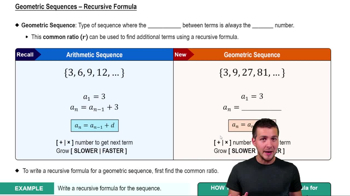
Geometric Sequences - Recursive Formula

Limits of Sequences

The limit of a sequence describes the value that the terms approach as the number of terms goes to infinity. For the aspirin dosing problem, finding the limit of the sequence representing drug concentration helps determine the steady-state amount in the bloodstream after many doses. This concept is key to confirming long-term behavior of the drug level.
Video consigliato:
8:22
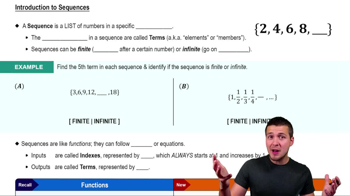
Introduction to Sequences

Half-Life and Exponential Decay

Half-life is the time required for a substance to reduce to half its initial amount, modeling exponential decay. Here, aspirin’s half-life of 24 hours means the drug amount halves every day. This decay rate defines the common ratio in the geometric sequence and is crucial for setting up the problem mathematically.
Video consigliato:
09:29
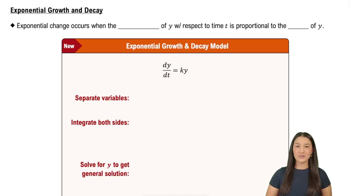
Exponential Growth & Decay
Pratica correlata
Domanda del libro di testo

67–70. Formulas for sequences of partial sums Consider the following infinite series.


c.Make a conjecture for the value of the series.


∑⁽∞⁾ₖ₌₁2⁄[(2k − 1)(2k + 1)]

92
views

Domanda del libro di testo

{Use of Tech} A savings plan

James begins a savings plan in which he deposits \$100 at the beginning of each month into an account that earns 9% interest annually, or equivalently, 0.75% per month.

To be clear, on the first day of each month, the bank adds 0.75% of the current balance as interest, and then James deposits \$100.


Let Bₙ be the balance in the account after the nᵗʰ payment, where B₀ = \$0.


c.How many months are needed to reach a balance of \$5000?

43
views
Domanda del libro di testo

Explain why or why not

Determine whether the following statements are true and give an explanation or counterexample.


c.The convergent sequences {aₙ} and {bₙ} differ in their first 100 terms, but aₙ = bₙ for n > 100.

It follows that limₙ→∞aₙ = limₙ→∞bₙ.

58
views
Domanda del libro di testo

27–34. Working with sequences Several terms of a sequence {aₙ}ₙ₌₁∞ are given.

c. Find an explicit formula for the nth term of the sequence.


{1, 3, 9, 27, 81, ......}

60
views
Domanda del libro di testo

27–34. Working with sequences Several terms of a sequence {aₙ}ₙ₌₁∞ are given.

c. Find an explicit formula for the nth term of the sequence.


{-5, 5, -5, 5, ......}

29
views
Domanda del libro di testo

41–44. {Use of Tech} Remainders and estimates Consider the following convergent series.


c. Find lower and upper bounds (Lₙ and Uₙ, respectively) on the exact value of the series.


43. ∑ (k = 1 to ∞) 1 / 3ᵏ

147
views