Ch. 11 - Power Series
Briggs - Calculus: Early Transcendentals 3rd Edition
Briggs3rd EditionCalculus: Early TranscendentalsISBN: 9780136847243Non è quello che usi tu?Cambia libro di testo
Capitolo 11, Problema 11.3.71

Any method


a. Use any analytical method to find the first four nonzero terms of the Taylor series centered at 0 for the following functions. You do not need to use the definition of the Taylor series coefficients.


b. Determine the radius of convergence of the series.


f(x) = (1 + x²)⁻²/³

Guida verificata passo dopo passo
1
Identify the function given: \(f(x) = (1 + x^{2})^{-\frac{2}{3}}\). We want to find the first four nonzero terms of its Taylor series centered at 0 (Maclaurin series).
Recall the generalized binomial series expansion for \((1 + u)^{k}\) where \(k\) is any real number: \[ (1 + u)^{k} = \sum_{n=0}^{\infty} \binom{k}{n} u^{n} = 1 + k u + \frac{k(k-1)}{2!} u^{2} + \frac{k(k-1)(k-2)}{3!} u^{3} + \cdots \] Here, \(u = x^{2}\) and \(k = -\frac{2}{3}\).
Write out the first four terms explicitly by substituting \(u = x^{2}\) and calculating the binomial coefficients: - Term 0: \(\binom{k}{0} u^{0} = 1\) - Term 1: \(\binom{k}{1} u^{1} = k x^{2}\) - Term 2: \(\binom{k}{2} u^{2} = \frac{k(k-1)}{2!} x^{4}\) - Term 3: \(\binom{k}{3} u^{3} = \frac{k(k-1)(k-2)}{3!} x^{6}\)
Substitute \(k = -\frac{2}{3}\) into each coefficient and simplify the expressions for the coefficients of \(x^{2}\), \(x^{4}\), and \(x^{6}\). This will give the first four nonzero terms of the Taylor series: \[ f(x) = 1 + \left(-\frac{2}{3}\right) x^{2} + \frac{\left(-\frac{2}{3}\right)\left(-\frac{5}{3}\right)}{2} x^{4} + \frac{\left(-\frac{2}{3}\right)\left(-\frac{5}{3}\right)\left(-\frac{8}{3}\right)}{6} x^{6} + \cdots \]
To find the radius of convergence, note that the binomial series for \((1 + u)^{k}\) converges when \(|u| < 1\). Since \(u = x^{2}\), the radius of convergence in terms of \(x\) is determined by \(|x^{2}| < 1\), which simplifies to \(|x| < 1\). Thus, the radius of convergence is 1.

Risposta video verificata per un problema simile:

Questa soluzione video è stata consigliata dai nostri tutor come utile per risolvere questo problema.
Durata del video:
3m

Concetti chiave

Ecco i concetti essenziali che devi comprendere per rispondere correttamente alla domanda.

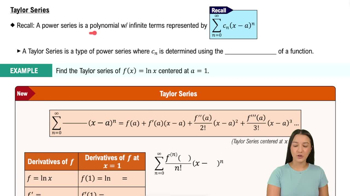
Taylor Series Expansion

A Taylor series represents a function as an infinite sum of terms calculated from the derivatives at a single point, typically centered at zero (Maclaurin series). Finding the first four nonzero terms involves computing derivatives or using known expansions to approximate the function near that point.
Video consigliato:
08:42
Taylor Series

Binomial Series for Non-Integer Exponents

The binomial series generalizes the binomial theorem to real exponents, allowing expansion of expressions like (1 + x)^k where k is any real number. This method is useful for functions like (1 + x²)^(-2/3), enabling term-by-term expansion without directly computing derivatives.
Video consigliato:
Percorso guidato
06:45
Intro to Series: Partial Sums

Radius of Convergence

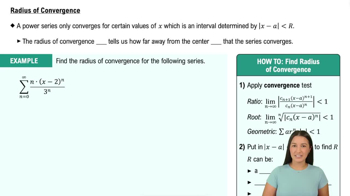
The radius of convergence defines the interval around the center point within which the Taylor series converges to the function. It can be found using tests like the ratio or root test, and depends on the function's singularities in the complex plane relative to the expansion point.
Video consigliato:
07:36
Radius of Convergence