Ch. 11 - Power Series
Briggs - Calculus: Early Transcendentals 3rd Edition
Briggs3rd EditionCalculus: Early TranscendentalsISBN: 9780136847243Non è quello che usi tu?Cambia libro di testo
Capitolo 11, Problema 11.2.9

Radius and interval of convergence Determine the radius and interval of convergence of the following power series.


∑ₖ₌₀∞ (2x)ᵏ

Guida verificata passo dopo passo
1
Identify the given power series: \(\sum_{k=0}^{\infty} (2x)^k\). This is a geometric series with the general term \(a_k = (2x)^k\).
Recall that a geometric series \(\sum_{k=0}^{\infty} r^k\) converges if and only if \(|r| < 1\). Here, the ratio \(r\) is \$2x$.
Set up the inequality for convergence: \(|2x| < 1\). This inequality will help us find the radius of convergence.
Solve the inequality \(|2x| < 1\) to find the interval for \(x\): dividing both sides by 2 gives \(|x| < \frac{1}{2}\). This means the radius of convergence \(R\) is \(\frac{1}{2}\).
Determine the interval of convergence by considering the endpoints \(x = -\frac{1}{2}\) and \(x = \frac{1}{2}\). Test these values in the original series to check if the series converges or diverges at the endpoints.

Risposta video verificata per un problema simile:

Questa soluzione video è stata consigliata dai nostri tutor come utile per risolvere questo problema.
Durata del video:
4m

Concetti chiave

Ecco i concetti essenziali che devi comprendere per rispondere correttamente alla domanda.

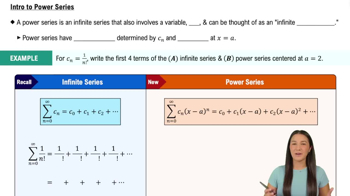
Power Series

A power series is an infinite sum of terms in the form a_k(x - c)^k, where a_k are coefficients and c is the center. Understanding power series helps analyze functions as infinite polynomials and study their convergence behavior around the center point.
Video consigliato:
05:58
Intro to Power Series

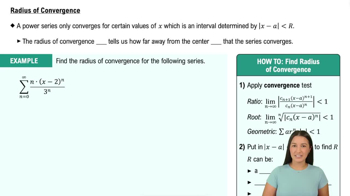
Radius of Convergence

The radius of convergence is the distance from the center within which a power series converges absolutely. It can be found using tests like the Ratio Test, and it defines the interval where the series represents a valid function.
Video consigliato:
07:36
Radius of Convergence

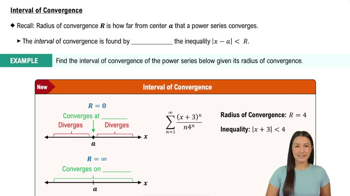
Interval of Convergence

The interval of convergence is the set of x-values for which the power series converges. It includes all points within the radius of convergence and requires checking endpoints separately to determine if the series converges there.
Video consigliato:
08:44
Interval of Convergence
Pratica correlata
Domanda del libro di testo

Suppose you know the Maclaurin series for f and that it converges to f(x) for |x|<1. How do you find the Maclaurin series for f(x²) and where does it converge?

67
views

Domanda del libro di testo

{Use of Tech} A different kind of approximation When approximating a function f using a Taylor polynomial, we use information about f and its derivative at one point. An alternative approach (called interpolation) uses information about f at several different points. Suppose we wish to approximate f(x)=sin x on the interval [0, π].


a. Write the (quadratic) Taylor polynomial p₂ for f centered at π/2.


b. Now consider a quadratic interpolating polynomial q(x) = ax² + bx + c. The coefficients a, b, and c are chosen such that the following conditions are satisfied:

q(0) = f(0), q(π/2) = f(π/2), and q(π) = f(π)


Show that q(x) = −(4/π²)x² + (4/π)x.


c. Graph f, p₂, and q on [0, π].


d. Find the error in approximating f(x) = sin x at the points π/4, π/2, 3π/4, and π using p₂ and q.


e. Which function, p₂ or q, is a better approximation to f on [0, π]? Explain.

52
views
Domanda del libro di testo

Probability: tossing for a head The expected (average) number of tosses of a fair coin required to obtain the first head is ∑ₖ₌₁∞ k(1/2)ᵏ. Evaluate this series and determine the expected number of tosses. (Hint: Differentiate a geometric series.) 

41
views
Domanda del libro di testo

{Use of Tech} Estimating errors Use the remainder to find a bound on the error in approximating the following quantities with the nth-order Taylor polynomial centered at 0. Estimates are not unique.


sin 0.3, n = 4

72
views
Domanda del libro di testo

Any method


a. Use any analytical method to find the first four nonzero terms of the Taylor series centered at 0 for the following functions. You do not need to use the definition of the Taylor series coefficients.


b. Determine the radius of convergence of the series.


f(x) = (1 + x²)⁻²/³

69
views
Domanda del libro di testo

Manipulating Taylor series Use the Taylor series in Table 11.5 to find the first four nonzero terms of the Taylor series for the following functions centered at 0.


ln (1 + x²)

78
views