Ch. 11 - Power Series
Briggs - Calculus: Early Transcendentals 3rd Edition
Briggs3rd EditionCalculus: Early TranscendentalsISBN: 9780136847243Non è quello che usi tu?Cambia libro di testo
Capitolo 11, Problema 11.4.37

Approximating definite integrals Use a Taylor series to approximate the following definite integrals. Retain as many terms as needed to ensure the error is less than 10⁻⁴.∫₀⁰ᐧ²⁵ e⁻ˣ² dx

Guida verificata passo dopo passo
1
Recognize that the integral involves the function \(f(x) = e^{-x^2}\), which does not have an elementary antiderivative, making it a good candidate for approximation using a Taylor series expansion.
Write the Taylor series expansion of \(e^{-x^2}\) centered at \(x=0\). Recall that the exponential function \(e^u\) can be expanded as \(\sum_{n=0}^{\infty} \frac{u^n}{n!}\). Here, \(u = -x^2\), so the series becomes \(e^{-x^2} = \sum_{n=0}^{\infty} \frac{(-1)^n x^{2n}}{n!}\).
Substitute the Taylor series into the integral to approximate it: \(\int_0^{0.25} e^{-x^2} \, dx = \int_0^{0.25} \sum_{n=0}^{\infty} \frac{(-1)^n x^{2n}}{n!} \, dx\). Interchange the integral and the summation (justified by uniform convergence on the interval) to get \(\sum_{n=0}^{\infty} \frac{(-1)^n}{n!} \int_0^{0.25} x^{2n} \, dx\).
Evaluate the integral inside the summation: \(\int_0^{0.25} x^{2n} \, dx = \frac{(0.25)^{2n+1}}{2n+1}\). So the approximation becomes \(\sum_{n=0}^{\infty} \frac{(-1)^n}{n!} \cdot \frac{(0.25)^{2n+1}}{2n+1}\).
Determine how many terms to retain by estimating the remainder term to ensure the error is less than \(10^{-4}\). Use the alternating series remainder estimation or compare the magnitude of the next term to \(10^{-4}\). Stop adding terms once the next term's absolute value is smaller than this threshold.

Risposta video verificata per un problema simile:

Questa soluzione video è stata consigliata dai nostri tutor come utile per risolvere questo problema.
Durata del video:
2m

Concetti chiave

Ecco i concetti essenziali che devi comprendere per rispondere correttamente alla domanda.

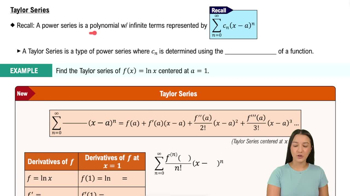
Taylor Series Expansion

A Taylor series represents a function as an infinite sum of terms calculated from the function's derivatives at a single point. For e^(-x²), expanding around x=0 allows approximation by polynomials, simplifying integration. Retaining enough terms ensures the approximation meets the desired accuracy.
Video consigliato:
08:42
Taylor Series

Definite Integral Approximation Using Series

Integrating a function approximated by a Taylor series term-by-term converts the integral into a sum of integrals of polynomials. This method simplifies evaluating definite integrals that lack elementary antiderivatives, like ∫₀^{0.25} e^{-x²} dx.
Video consigliato:
Percorso guidato
05:43
Definition of the Definite Integral

Error Estimation and Convergence Criteria

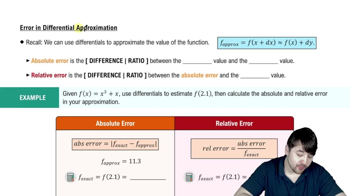
To ensure the approximation error is below 10⁻⁴, one must estimate the remainder term of the Taylor series. This involves bounding the next term's magnitude or using known error formulas, guiding how many terms to retain for the integral approximation.
Video consigliato:
Percorso guidato
04:57
Determining Error and Relative Error
Pratica correlata
Domanda del libro di testo

{Use of Tech} Approximating definite integrals Use a Taylor series to approximate the following definite integrals. Retain as many terms as needed to ensure the error is less than 10⁻⁴.

∫₀⁰ᐧ² (ln (1 + t))/t dt

88
views

Domanda del libro di testo

Use of Tech Linear and quadratic approximation


a. Find the linear approximating polynomial for the following functions centered at the given point a.


b. Find the quadratic approximating polynomial for the following functions centered at a.


c Use the polynomials obtained in parts (a) and (b) to approximate the given quantity.


Find the Taylor polynomial p₃ centered at a=e for f(x)=ln x.

68
views
Domanda del libro di testo

Combining power series Use the geometric series


f(x) = 1/(1-x) = ∑ₖ₌₀∞ xᵏ, for |x| < 1,


to find the power series representation for the following functions (centered at 0). Give the interval of convergence of the new series.


f(x³) = 1/(1 − x³)

59
views
Domanda del libro di testo

Suppose you use a second-order Taylor polynomial centered at 0 to approximate a function f. What matching conditions are satisfied by the polynomial?

76
views
Domanda del libro di testo

Radius and interval of convergence Determine the radius and interval of convergence of the following power series.


∑ₖ₌₁∞ ((−1)ᵏ⁺¹(x−1)ᵏ)/k

63
views
Domanda del libro di testo

Power series for derivatives


a. Differentiate the Taylor series centered at 0 for the following functions.

b. Identify the function represented by the differentiated series.

c. Give the interval of convergence of the power series for the derivative.


f(x) = ln (1 + x)

69
views