
Ch. 11 - Power Series
Briggs - Calculus: Early Transcendentals 3rd Edition
Briggs3rd EditionCalculus: Early TranscendentalsISBN: 9780136847243Non è quello che usi tu?Cambia libro di testo
Capitolo 11, Problema 11.2.44

Combining power series Use the geometric series


f(x) = 1/(1-x) = ∑ₖ₌₀∞ xᵏ, for |x| < 1,


to find the power series representation for the following functions (centered at 0). Give the interval of convergence of the new series.


f(x³) = 1/(1 − x³)

Guida verificata passo dopo passo
1
Recall the geometric series formula: \(f(x) = \frac{1}{1 - x} = \sum_{k=0}^{\infty} x^{k}\) for \(|x| < 1\).
To find the power series for \(f(x^{3}) = \frac{1}{1 - x^{3}}\), substitute \(x^{3}\) in place of \(x\) in the original series.
This gives \(f(x^{3}) = \sum_{k=0}^{\infty} (x^{3})^{k} = \sum_{k=0}^{\infty} x^{3k}\).
The power series representation is therefore \(\sum_{k=0}^{\infty} x^{3k}\), which is centered at 0.
Determine the interval of convergence by applying the original condition \(|x| < 1\) to the new variable: since the series is in terms of \(x^{3}\), the condition becomes \(|x^{3}| < 1\), which simplifies to \(|x| < 1\).

Risposta video verificata per un problema simile:

Questa soluzione video è stata consigliata dai nostri tutor come utile per risolvere questo problema.
Durata del video:
3m

Concetti chiave

Ecco i concetti essenziali che devi comprendere per rispondere correttamente alla domanda.

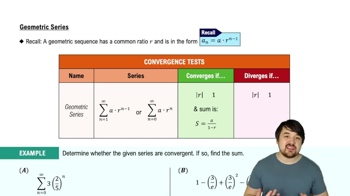
Geometric Series and Its Power Series Representation

A geometric series is a sum of the form ∑ x^k for k from 0 to infinity, which converges to 1/(1-x) when |x| < 1. This fundamental series allows us to express functions as infinite sums, facilitating manipulation and analysis of functions within their radius of convergence.
Video consigliato:
Percorso guidato
06:00
Geometric Series

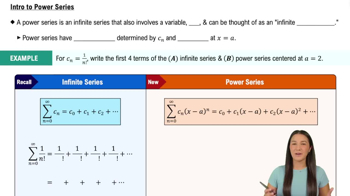
Substitution in Power Series

Substitution involves replacing the variable x in a known power series with another expression, such as x³. This transforms the original series into a new series representing a related function, while maintaining the structure of the series and adjusting the interval of convergence accordingly.
Video consigliato:
05:58
Intro to Power Series

Interval of Convergence

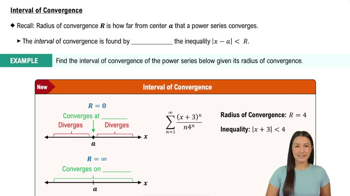
The interval of convergence is the set of x-values for which a power series converges. When substituting variables, the interval changes based on the new expression's magnitude. Determining this interval ensures the validity of the power series representation for the function.
Video consigliato:
08:44
Interval of Convergence
Pratica correlata
Domanda del libro di testo

Use of Tech Linear and quadratic approximation


a. Find the linear approximating polynomial for the following functions centered at the given point a.


b. Find the quadratic approximating polynomial for the following functions centered at a.


c Use the polynomials obtained in parts (a) and (b) to approximate the given quantity.


Find the Taylor polynomial p₃ centered at a=e for f(x)=ln x.

68
views
Domanda del libro di testo

Suppose you use a second-order Taylor polynomial centered at 0 to approximate a function f. What matching conditions are satisfied by the polynomial?

76
views
Domanda del libro di testo

Working with binomial series Use properties of power series, substitution, and factoring to find the first four nonzero terms of the Maclaurin series for the following functions. Use the Maclaurin series


(1 + x)⁻² = 1 − 2x + 3x² − 4x³ + ⋯, for −1 < x < 1.


1/(3 + 4x)²

44
views
Domanda del libro di testo

Radius and interval of convergence Determine the radius and interval of convergence of the following power series.


∑ₖ₌₁∞ ((−1)ᵏ⁺¹(x−1)ᵏ)/k

63
views
Domanda del libro di testo

Power series for derivatives


a. Differentiate the Taylor series centered at 0 for the following functions.

b. Identify the function represented by the differentiated series.

c. Give the interval of convergence of the power series for the derivative.


f(x) = ln (1 + x)

69
views
Domanda del libro di testo

Approximating definite integrals Use a Taylor series to approximate the following definite integrals. Retain as many terms as needed to ensure the error is less than 10⁻⁴.∫₀⁰ᐧ²⁵ e⁻ˣ² dx

106
views