Ch. 11 - Power Series
Briggs - Calculus: Early Transcendentals 3rd Edition
Briggs3rd EditionCalculus: Early TranscendentalsISBN: 9780136847243Non è quello che usi tu?Cambia libro di testo
Capitolo 11, Problema 11.R.65e

Approximating ln 2 Consider the following three ways to approximate
ln 2.
e. Using four terms of the series, which of the three series derived in parts (a)–(d) gives the best approximation to ln 2? Can you explain why?

Guida verificata passo dopo passo
1
Recall the three series expansions for \( \ln 2 \) derived in parts (a)–(d). Typically, these might include: the Taylor series expansion of \( \ln(1+x) \) at \( x=1 \), the alternating series expansion, or other related series. Identify each series explicitly before proceeding.
Write down the first four terms of each series. For example, if the series is \( \ln(1+x) = x - \frac{x^2}{2} + \frac{x^3}{3} - \frac{x^4}{4} + \cdots \), substitute \( x=1 \) and list the first four terms for each series.
Calculate the partial sums of the first four terms for each series (without simplifying to a final decimal). This means summing the terms as they are, keeping the fractions or expressions intact.
Compare the magnitude of the remainder (error) term for each series after four terms. Use the Alternating Series Estimation Theorem or remainder bounds for Taylor series to estimate which series has the smallest error after four terms.
Explain why the series with the smallest remainder or error term provides the best approximation. Typically, this is because the terms decrease in magnitude faster or the series converges more quickly at \( x=1 \).

Risposta video verificata per un problema simile:

Questa soluzione video è stata consigliata dai nostri tutor come utile per risolvere questo problema.
Durata del video:
2m

Concetti chiave

Ecco i concetti essenziali che devi comprendere per rispondere correttamente alla domanda.

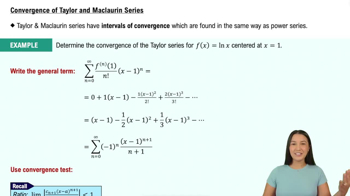
Taylor and Maclaurin Series

Taylor and Maclaurin series express functions as infinite sums of polynomial terms derived from their derivatives at a point. Approximating ln(2) often involves using a Maclaurin series expansion of ln(1+x) with x=1. Understanding how these series are constructed helps in selecting and evaluating approximations.
Video consigliato:
08:26
Convergence of Taylor & Maclaurin Series

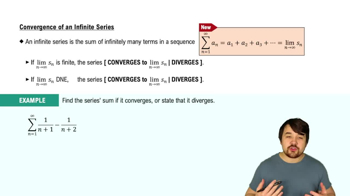
Convergence and Error in Series Approximations

The accuracy of approximating functions using series depends on how quickly the series converges and the size of the remainder (error) after a finite number of terms. Some series converge faster near certain points, making their partial sums better approximations. Comparing errors helps determine which series best approximates ln(2) with four terms.
Video consigliato:
Percorso guidato
06:52
Convergence of an Infinite Series

Alternating Series and Error Bounds

Many series for ln(1+x) are alternating series, where terms alternate in sign. The Alternating Series Estimation Theorem states that the error after n terms is less than or equal to the absolute value of the next term. Recognizing this helps explain why some series provide better approximations for ln(2) when truncated.
Video consigliato:
Percorso guidato
06:00
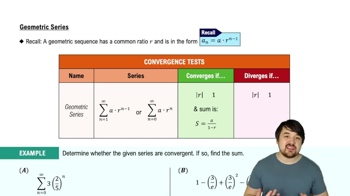
Geometric Series