Ch. 11 - Power Series
Briggs - Calculus: Early Transcendentals 3rd Edition
Briggs3rd EditionCalculus: Early TranscendentalsISBN: 9780136847243Non è quello che usi tu?Cambia libro di testo
Capitolo 11, Problema 11.4.50

Approximating real numbers Use an appropriate Taylor series to find the first four nonzero terms of an infinite series that is equal to the following numbers.
tan ⁻¹ (1/2)

Guida verificata passo dopo passo
1
Recall that the Taylor series expansion for \( \tan^{-1}(x) \) centered at \( x=0 \) (also known as the Maclaurin series) is given by the infinite series: \[ \tan^{-1}(x) = \sum_{n=0}^{\infty} (-1)^n \frac{x^{2n+1}}{2n+1} = x - \frac{x^3}{3} + \frac{x^5}{5} - \frac{x^7}{7} + \cdots \] This series converges for \( |x| \leq 1 \).
Since we want to approximate \( \tan^{-1}(1/2) \), substitute \( x = \frac{1}{2} \) into the series: \[ \tan^{-1}\left(\frac{1}{2}\right) = \frac{1}{2} - \frac{\left(\frac{1}{2}\right)^3}{3} + \frac{\left(\frac{1}{2}\right)^5}{5} - \frac{\left(\frac{1}{2}\right)^7}{7} + \cdots \] This gives the infinite series representation for \( \tan^{-1}(1/2) \).
Identify the first four nonzero terms explicitly by writing each term with the powers and denominators clearly: 1st term: \( \frac{1}{2} \) 2nd term: \( - \frac{(1/2)^3}{3} = - \frac{1/8}{3} \) 3rd term: \( + \frac{(1/2)^5}{5} = + \frac{1/32}{5} \) 4th term: \( - \frac{(1/2)^7}{7} = - \frac{1/128}{7} \)
Write the partial sum of the first four nonzero terms as: \[ \tan^{-1}\left(\frac{1}{2}\right) \approx \frac{1}{2} - \frac{1}{24} + \frac{1}{160} - \frac{1}{896} \] This expression represents the approximation using the first four terms of the Taylor series.
To summarize, the steps to find the first four nonzero terms are: - Use the Maclaurin series for \( \tan^{-1}(x) \). - Substitute \( x = \frac{1}{2} \). - Write out the first four terms explicitly with powers and denominators. - Express the partial sum as the approximation of \( \tan^{-1}(1/2) \).

Risposta video verificata per un problema simile:

Questa soluzione video è stata consigliata dai nostri tutor come utile per risolvere questo problema.
Durata del video:
2m

Concetti chiave

Ecco i concetti essenziali che devi comprendere per rispondere correttamente alla domanda.

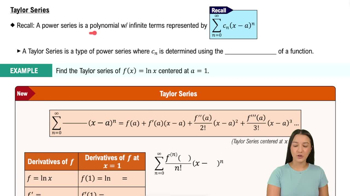
Taylor Series Expansion

A Taylor series represents a function as an infinite sum of terms calculated from the function's derivatives at a single point. It approximates functions near that point, allowing complex functions to be expressed as polynomials. For example, the Taylor series of arctan(x) at x=0 is used to approximate values like arctan(1/2).
Video consigliato:
08:42
Taylor Series

Maclaurin Series for arctan(x)

The Maclaurin series is a Taylor series centered at zero. For arctan(x), it is given by x - x^3/3 + x^5/5 - x^7/7 + ... . This alternating series converges for |x| ≤ 1 and is used to approximate arctan values by substituting x with the desired number, such as 1/2.
Video consigliato:
08:26
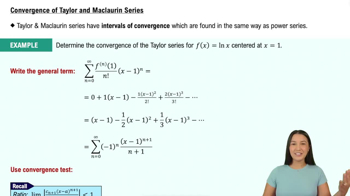
Convergence of Taylor & Maclaurin Series

Finding Nonzero Terms in a Series

When approximating a function using a Taylor series, identifying the first few nonzero terms involves calculating terms until four nonzero coefficients appear. This ensures a more accurate approximation. For arctan(1/2), the first four nonzero terms come from substituting x=1/2 into the first four terms of its Maclaurin series.
Video consigliato:
Percorso guidato
06:00
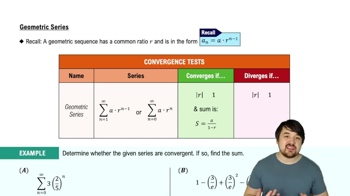
Geometric Series
Pratica correlata
Domanda del libro di testo

How are the Taylor polynomials for a function f centered at a related to the Taylor series of the function f centered at a?

56
views

Domanda del libro di testo

Working with binomial series Use properties of power series, substitution, and factoring to find the first four nonzero terms of the Maclaurin series for the following functions. Use the Maclaurin series


(1 + x)⁻² = 1 − 2x + 3x² − 4x³ + ⋯, for −1 < x < 1.


1/(3 + 4x)²

44
views
Domanda del libro di testo

Tangent line is p₁ Let f be differentiable at x=a


a. Find the equation of the line tangent to the curve y=f(x) at (a, f(a)).


b. Verify that the Taylor polynomial p_1 centered at a describes the tangent line found in part (a).

56
views
Domanda del libro di testo

Power series for derivatives


a. Differentiate the Taylor series centered at 0 for the following functions.

b. Identify the function represented by the differentiated series.

c. Give the interval of convergence of the power series for the derivative.


f(x) = ln (1 + x)

69
views
Domanda del libro di testo

{Use of Tech} Maximum error Use the remainder term to find a bound on the error in the following approximations on the given interval. Error bounds are not unique.


√(1+x) ≈ 1 + x/2 on [−0.1,0.1]

72
views
Domanda del libro di testo

{Use of Tech} Estimating errors Use the remainder to find a bound on the error in approximating the following quantities with the nth-order Taylor polynomial centered at 0. Estimates are not unique.


e⁰ᐧ²⁵, n=4

59
views