Ch. 11 - Power Series
Briggs - Calculus: Early Transcendentals 3rd Edition
Briggs3rd EditionCalculus: Early TranscendentalsISBN: 9780136847243Non è quello che usi tu?Cambia libro di testo
Capitolo 11, Problema 11.1.49

{Use of Tech} Estimating errors Use the remainder to find a bound on the error in approximating the following quantities with the nth-order Taylor polynomial centered at 0. Estimates are not unique.


e⁰ᐧ²⁵, n=4

Guida verificata passo dopo passo
1
Identify the function to approximate: here, it is \(f(x) = e^x\), and we want to approximate \(e^{0.25}\) using the 4th-order Taylor polynomial centered at 0.
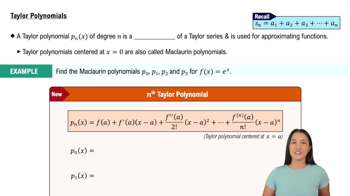
Recall the Taylor polynomial of order \(n\) for \(f(x)\) centered at 0 is given by: \[T_n(x) = \sum_{k=0}^n \frac{f^{(k)}(0)}{k!} x^k,\] where \(f^{(k)}(0)\) is the \(k\)th derivative of \(f\) evaluated at 0.
The remainder (error) term for the Taylor polynomial approximation is given by the Lagrange form: \[R_n(x) = \frac{f^{(n+1)}(c)}{(n+1)!} x^{n+1}\] for some \(c\) between 0 and \(x\).
Since \(f(x) = e^x\), all derivatives are \(e^x\), which are positive and increasing. To find an upper bound on the error, evaluate the maximum of \(|f^{(n+1)}(c)|\) on the interval between 0 and 0.25, which is \(e^{0.25}\) because \(e^x\) is increasing.
Substitute \(n=4\), \(x=0.25\), and the maximum derivative value into the remainder formula to get the error bound: \[|R_4(0.25)| \leq \frac{e^{0.25}}{5!} (0.25)^5.\] This expression gives a bound on the error when approximating \(e^{0.25}\) with the 4th-order Taylor polynomial centered at 0.

Risposta video verificata per un problema simile:

Questa soluzione video è stata consigliata dai nostri tutor come utile per risolvere questo problema.
Durata del video:
4m

Concetti chiave

Ecco i concetti essenziali che devi comprendere per rispondere correttamente alla domanda.

Taylor Polynomial Approximation

A Taylor polynomial approximates a function near a point using a finite sum of its derivatives at that point. The nth-order Taylor polynomial centered at 0 (Maclaurin polynomial) uses derivatives up to order n to estimate the function's value close to zero.
Video consigliato:
07:00
Taylor Polynomials

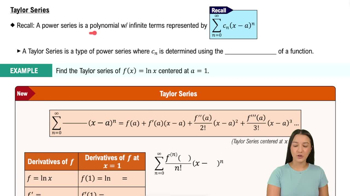
Remainder (Error) Term in Taylor Series

The remainder term quantifies the difference between the actual function value and its Taylor polynomial approximation. It provides an upper bound on the error, often expressed using the Lagrange form involving the (n+1)th derivative evaluated at some point in the interval.
Video consigliato:
08:42
Taylor Series

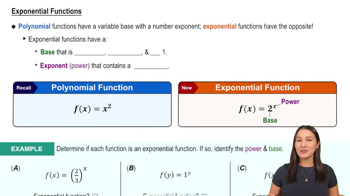
Bounding the Error for Exponential Functions

For functions like e^x, all derivatives are e^x, which are positive and increasing for positive x. To bound the error, evaluate the maximum value of the (n+1)th derivative on the interval from 0 to the point of approximation, ensuring the error estimate is valid.
Video consigliato:
6:13
Exponential Functions