Ch. 11 - Power Series
Briggs - Calculus: Early Transcendentals 3rd Edition
Briggs3rd EditionCalculus: Early TranscendentalsISBN: 9780136847243Non è quello che usi tu?Cambia libro di testo
Capitolo 11, Problema 11.R.47

Convergence Write the remainder term Rₙ(x) for the Taylor series for the following functions centered at the given point a. Then show that lim ₙ → ∞ |Rₙ(x)| = 0, for all x in the given interval.
ƒ(x) = sinh x + cosh x, a = 0, - ∞ < x < ∞

Guida verificata passo dopo passo
1
Identify the function and the center of the Taylor series expansion. Here, the function is \(f(x) = \sinh x + \cosh x\) and the center is \(a = 0\).
Recall the Taylor series remainder term in Lagrange form: \[R_n(x) = \frac{f^{(n+1)}(c)}{(n+1)!} (x - a)^{n+1}\] where \(c\) is some number between \(a\) and \(x\).
Find the \((n+1)\)-th derivative of \(f(x)\). Since \(f(x) = \sinh x + \cosh x\), note that the derivatives cycle in a predictable way. Compute \(f^{(n+1)}(x)\) explicitly or recognize the pattern.
Express the remainder term \(R_n(x)\) using the derivative found, substituting \(a=0\): \[R_n(x) = \frac{f^{(n+1)}(c)}{(n+1)!} x^{n+1}\] with \(c\) between \(0\) and \(x\).
To show that \(\lim_{n \to \infty} |R_n(x)| = 0\) for all real \(x\), analyze the growth of the numerator \(|f^{(n+1)}(c)|\) and the factorial in the denominator. Use the fact that factorial growth dominates exponential growth to conclude the limit is zero.

Risposta video verificata per un problema simile:

Questa soluzione video è stata consigliata dai nostri tutor come utile per risolvere questo problema.
Durata del video:
5m

Concetti chiave

Ecco i concetti essenziali che devi comprendere per rispondere correttamente alla domanda.

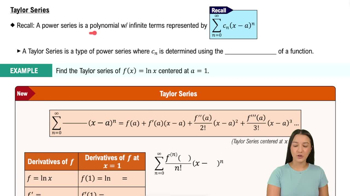
Taylor Series and Remainder Term

A Taylor series represents a function as an infinite sum of terms calculated from the derivatives at a single point. The remainder term Rₙ(x) measures the error between the function and its nth-degree Taylor polynomial. It is often expressed using the Lagrange form, involving the (n+1)th derivative evaluated at some point between a and x.
Video consigliato:
08:42
Taylor Series

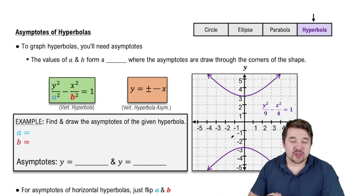
Hyperbolic Functions and Their Derivatives

The functions sinh x and cosh x are hyperbolic sine and cosine, respectively, with derivatives that cycle predictably: d/dx(sinh x) = cosh x and d/dx(cosh x) = sinh x. Understanding these derivatives helps in finding the Taylor series terms and the remainder for the combined function f(x) = sinh x + cosh x.
Video consigliato:
Percorso guidato
5:50
Asymptotes of Hyperbolas

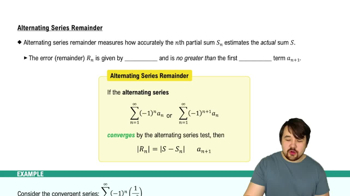
Limit of the Remainder Term and Convergence

To prove convergence of the Taylor series, we show that the remainder term Rₙ(x) approaches zero as n approaches infinity for all x in the interval. This involves bounding the remainder term and using properties of the function and its derivatives to demonstrate that the error vanishes, ensuring the series converges to the function.
Video consigliato:
Percorso guidato
06:32
Alternating Series Remainder