
Ch. 11 - Power Series
Briggs - Calculus: Early Transcendentals 3rd Edition
Briggs3rd EditionCalculus: Early TranscendentalsISBN: 9780136847243Non è quello che usi tu?Cambia libro di testo
Capitolo 11, Problema 11.R.2

Taylor polynomials Find the nth-order Taylor polynomial for the following functions centered at the given point a.
ƒ(x) = sin 2x, n = 3, a = 0

Guida verificata passo dopo passo
1
Identify the function and the point of expansion: here, the function is \(f(x) = \sin(2x)\) and the center is \(a = 0\).
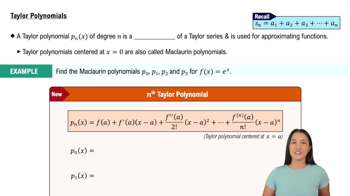
Recall the formula for the nth-order Taylor polynomial centered at \(a\): \[T_n(x) = \sum_{k=0}^n \frac{f^{(k)}(a)}{k!} (x - a)^k,\] where \(f^{(k)}(a)\) is the \(k\)th derivative of \(f\) evaluated at \(x = a\).
Compute the derivatives of \(f(x) = \sin(2x)\) up to the 3rd order: - \(f(x) = \sin(2x)\) - \(f'(x) = 2 \cos(2x)\) - \(f''(x) = -4 \sin(2x)\) - \(f^{(3)}(x) = -8 \cos(2x)\)
Evaluate each derivative at \(x = 0\): - \(f(0) = \sin(0) = 0\) - \(f'(0) = 2 \cos(0) = 2\) - \(f''(0) = -4 \sin(0) = 0\) - \(f^{(3)}(0) = -8 \cos(0) = -8\)
Construct the 3rd-order Taylor polynomial using the formula: \[T_3(x) = f(0) + \frac{f'(0)}{1!} x + \frac{f''(0)}{2!} x^2 + \frac{f^{(3)}(0)}{3!} x^3,\] and substitute the values found in the previous step.

Risposta video verificata per un problema simile:

Questa soluzione video è stata consigliata dai nostri tutor come utile per risolvere questo problema.
Durata del video:
4m

Concetti chiave

Ecco i concetti essenziali che devi comprendere per rispondere correttamente alla domanda.

Taylor Polynomial

A Taylor polynomial approximates a function near a point a by using a finite sum of derivatives of the function at a. The nth-order Taylor polynomial includes terms up to the nth derivative, providing a polynomial that closely matches the function's behavior near a.
Video consigliato:
07:00
Taylor Polynomials

Derivatives of Trigonometric Functions

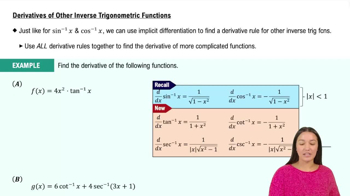
To construct the Taylor polynomial for ƒ(x) = sin(2x), you need to compute derivatives of sin(2x) at the point a. Knowing the derivatives of sine and cosine functions, and applying the chain rule for the inner function 2x, is essential for finding these values.
Video consigliato:
06:35
Derivatives of Other Inverse Trigonometric Functions

Centering at a Point (a = 0)

Centering the Taylor polynomial at a = 0 means the polynomial is expanded around x = 0, also called a Maclaurin polynomial. This simplifies calculations since derivatives are evaluated at zero, and powers of (x - 0) become powers of x.
Video consigliato:
04:50
Critical Points