Ch. 11 - Power Series
Briggs - Calculus: Early Transcendentals 3rd Edition
Briggs3rd EditionCalculus: Early TranscendentalsISBN: 9780136847243Non è quello che usi tu?Cambia libro di testo
Capitolo 11, Problema 11.2.54

Differentiating and integrating power series Find the power series representation for g centered at 0 by differentiating or integrating the power series for f (perhaps more than once). Give the interval of convergence for the resulting series.


g(x) = x/(1 + x²)² using f(x) = 1/(1 + x²)

Guida verificata passo dopo passo
1
Start with the given function \( f(x) = \frac{1}{1 + x^2} \). Recognize that this is a geometric series of the form \( \frac{1}{1 - (-x^2)} \), which can be expanded as a power series centered at 0: \( f(x) = \sum_{n=0}^\infty (-1)^n x^{2n} \).
To find \( g(x) = \frac{x}{(1 + x^2)^2} \), notice that it can be expressed in terms of the derivative of \( f(x) \). Differentiate \( f(x) \) with respect to \( x \) to relate it to \( g(x) \). Use the chain rule: \( f'(x) = \frac{d}{dx} \left( \frac{1}{1 + x^2} \right) = -\frac{2x}{(1 + x^2)^2} \).
Rearrange the derivative expression to isolate \( g(x) \): \( g(x) = \frac{x}{(1 + x^2)^2} = -\frac{1}{2} f'(x) \). This means \( g(x) \) can be represented as \( -\frac{1}{2} \) times the derivative of the power series for \( f(x) \).
Differentiate the power series term-by-term: \( f(x) = \sum_{n=0}^\infty (-1)^n x^{2n} \) implies \( f'(x) = \sum_{n=1}^\infty (-1)^n 2n x^{2n-1} \). Then multiply by \( -\frac{1}{2} \) to get the power series for \( g(x) \): \( g(x) = -\frac{1}{2} f'(x) = \sum_{n=1}^\infty (-1)^{n+1} n x^{2n-1} \).
Determine the interval of convergence. Since the original series for \( f(x) \) converges for \( |x| < 1 \), and differentiation does not change the radius of convergence, the power series for \( g(x) \) also converges for \( |x| < 1 \).

Risposta video verificata per un problema simile:

Questa soluzione video è stata consigliata dai nostri tutor come utile per risolvere questo problema.
Durata del video:
4m

Concetti chiave

Ecco i concetti essenziali che devi comprendere per rispondere correttamente alla domanda.

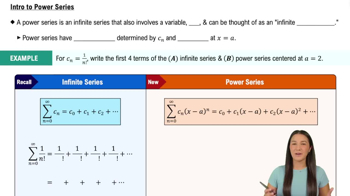
Power Series Representation

A power series is an infinite sum of terms in the form a_n(x - c)^n, representing functions as polynomials of infinite degree centered at c. Understanding how to express functions as power series allows manipulation through differentiation and integration term-by-term, facilitating approximation and analysis.
Video consigliato:
05:58
Intro to Power Series

Term-by-Term Differentiation and Integration of Power Series

Power series can be differentiated or integrated term-by-term within their interval of convergence. This property enables finding new series representations for related functions by applying calculus operations to known series, preserving convergence and simplifying complex function analysis.
Video consigliato:
05:58
Intro to Power Series

Interval of Convergence

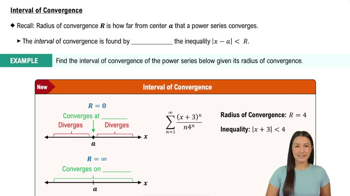
The interval of convergence is the set of x-values for which a power series converges to a finite value. Determining this interval is crucial after differentiation or integration, as these operations can alter convergence properties, ensuring the resulting series accurately represents the function within that domain.
Video consigliato:
08:44
Interval of Convergence