Ch. 11 - Power Series
Briggs - Calculus: Early Transcendentals 3rd Edition
Briggs3rd EditionCalculus: Early TranscendentalsISBN: 9780136847243Non è quello che usi tu?Cambia libro di testo
Capitolo 11, Problema 11.4.25

Power series for derivatives


a. Differentiate the Taylor series centered at 0 for the following functions.
b. Identify the function represented by the differentiated series.
c. Give the interval of convergence of the power series for the derivative.


f(x) = eˣ

Guida verificata passo dopo passo
1
Start with the Taylor series expansion of the function \(f(x) = e^x\) centered at 0, which is given by the infinite sum: \[f(x) = \sum_{n=0}^{\infty} \frac{x^n}{n!}\]
Differentiate the series term-by-term with respect to \(x\). Using the power rule for differentiation, the derivative of each term \(\frac{x^n}{n!}\) is: \[\frac{d}{dx} \left( \frac{x^n}{n!} \right) = \frac{n x^{n-1}}{n!} = \frac{x^{n-1}}{(n-1)!}\] Note that for \(n=0\), the term is a constant and its derivative is zero, so the summation index will start from \(n=1\) after differentiation.
Rewrite the differentiated series by adjusting the index to start from \(n=0\) for convenience. Let \(m = n - 1\), then: \[f'(x) = \sum_{m=0}^{\infty} \frac{x^m}{m!}\]
Recognize that the differentiated series is the same as the original Taylor series for \(e^x\). Therefore, the function represented by the differentiated series is also \(e^x\).
Determine the interval of convergence. Since the original series for \(e^x\) converges for all real \(x\), the differentiated series will have the same interval of convergence, which is \((-\infty, \infty)\).

Risposta video verificata per un problema simile:

Questa soluzione video è stata consigliata dai nostri tutor come utile per risolvere questo problema.
Durata del video:
6m

Concetti chiave

Ecco i concetti essenziali che devi comprendere per rispondere correttamente alla domanda.

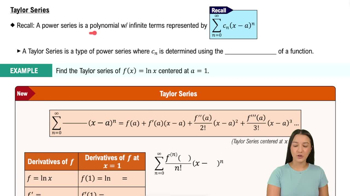
Taylor Series Expansion

A Taylor series represents a function as an infinite sum of terms calculated from the function's derivatives at a single point, often zero (Maclaurin series). For eˣ, the series is ∑(xⁿ/n!), which converges for all real x. Understanding this expansion is essential to differentiate the series term-by-term.
Video consigliato:
08:42
Taylor Series

Term-by-Term Differentiation of Power Series

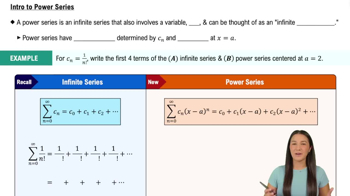
Power series can be differentiated term-by-term within their interval of convergence. Differentiating each term of the Taylor series of eˣ involves applying the power rule to xⁿ/n!, resulting in a new series representing the derivative function. This process helps identify the derivative's power series.
Video consigliato:
05:58
Intro to Power Series

Interval of Convergence

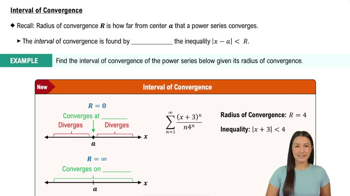
The interval of convergence is the set of x-values for which a power series converges. Differentiating a power series does not change its radius of convergence, so the interval for the derivative's series is the same as the original. For eˣ, the series converges for all real numbers, meaning the interval is (-∞, ∞).
Video consigliato:
08:44
Interval of Convergence
Pratica correlata
Domanda del libro di testo

Remainders Find the remainder Rₙ for the nth−order Taylor polynomial centered at a for the given functions. Express the result for a general value of n.


f(x) = sin x, a = π/2

59
views

Domanda del libro di testo

Derivative trick Here is an alternative way to evaluate higher derivatives of a function f that may save time. Suppose you can find the Taylor series for f centered at the point a without evaluating derivatives (for example, from a known series). Then f⁽ᵏ⁾(a)=k! multiplied by the coefficient of (x−a)ᵏ. Use this idea to evaluate f⁽³⁾(0) and f⁽⁴⁾(0) for the following functions. Use known series and do not evaluate derivatives.


f(x) = ∫₀ˣ sin t² dt

74
views
Domanda del libro di testo

Radius and interval of convergence Determine the radius and interval of convergence of the following power series.

∑ₖ₌₀∞ k(x−1)ᵏ

71
views
Domanda del libro di testo

Representing functions by power series Identify the functions represented by the following power series.

∑ₖ₌₀∞ 2ᵏ x²ᵏ⁺¹

49
views
Domanda del libro di testo

Differentiating and integrating power series Find the power series representation for g centered at 0 by differentiating or integrating the power series for f (perhaps more than once). Give the interval of convergence for the resulting series.


g(x) = x/(1 + x²)² using f(x) = 1/(1 + x²)

80
views
Domanda del libro di testo

Does the accuracy of an approximation given by a Taylor polynomial generally increase or decrease with the order of the approximation? Explain.

84
views