Ch. 11 - Power Series
Briggs - Calculus: Early Transcendentals 3rd Edition
Briggs3rd EditionCalculus: Early TranscendentalsISBN: 9780136847243Non è quello che usi tu?Cambia libro di testo
Capitolo 11, Problema 11.3.67a

Explain why or why not Determine whether the following statements are true and give an explanation or counterexample.
a. The function f(x) = √x has a Taylor series centered at 0.

Guida verificata passo dopo passo
1
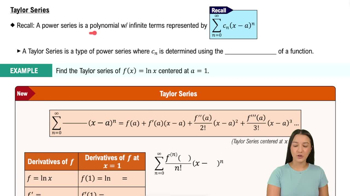
Recall that a Taylor series of a function \(f(x)\) centered at \(a\) is given by the infinite sum \(\displaystyle \sum_{n=0}^{\infty} \frac{f^{(n)}(a)}{n!} (x - a)^n\), where \(f^{(n)}(a)\) is the \(n\)-th derivative of \(f\) evaluated at \(a\).
For the function \(f(x) = \sqrt{x} = x^{1/2}\), consider the point \(a = 0\) where the Taylor series is centered. We need to check if all derivatives \(f^{(n)}(0)\) exist and are finite.
Calculate the first derivative: \(f'(x) = \frac{1}{2} x^{-1/2}\). Notice that as \(x \to 0^+\), \(f'(x)\) tends to infinity, so \(f'(0)\) is not defined.
Since the first derivative at \(x=0\) does not exist, the Taylor series centered at 0 cannot be formed because the coefficients \(\frac{f^{(n)}(0)}{n!}\) are not all defined.
Therefore, the function \(f(x) = \sqrt{x}\) does not have a Taylor series centered at 0. This is because the function is not differentiable at 0 in the usual sense required for a Taylor series expansion.

Risposta video verificata per un problema simile:

Questa soluzione video è stata consigliata dai nostri tutor come utile per risolvere questo problema.
Durata del video:
2m

Concetti chiave

Ecco i concetti essenziali che devi comprendere per rispondere correttamente alla domanda.

Taylor Series and Its Definition

A Taylor series represents a function as an infinite sum of terms calculated from the derivatives of the function at a single point. It requires the function to be infinitely differentiable at that point, and the series converges to the function within some interval around the center.
Video consigliato:
08:42
Taylor Series

Differentiability of f(x) = √x at x = 0

The function f(x) = √x is defined for x ≥ 0, but its derivative f'(x) = 1/(2√x) becomes unbounded as x approaches 0 from the right. This means f(x) is not differentiable at 0 in the usual sense, which affects the existence of a Taylor series centered at 0.
Video consigliato:
04:56
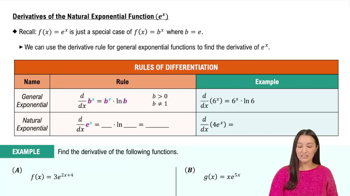
Derivative of the Natural Exponential Function (e^x)

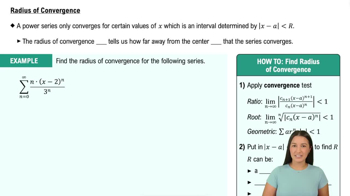
Radius of Convergence and Analyticity

For a Taylor series to represent a function, the function must be analytic at the center point, meaning it can be expressed as a convergent power series there. Since f(x) = √x is not analytic at 0 due to the non-differentiability, its Taylor series centered at 0 does not exist or does not converge to the function.
Video consigliato:
07:36
Radius of Convergence
Pratica correlata
Domanda del libro di testo

Taylor series and interval of convergence


a. Use the definition of a Taylor/Maclaurin series to find the first four nonzero terms of the Taylor series for the given function centered at a.


f(x)=3ˣ, a=0

88
views

Domanda del libro di testo

Taylor series and interval of convergence


a. Use the definition of a Taylor/Maclaurin series to find the first four nonzero terms of the Taylor series for the given function centered at a.


f(x) = tan ⁻¹ (x/2), a = 0

85
views
Domanda del libro di testo

Matching functions with polynomials Match functions a–f with Taylor polynomials A–F (all centered at 0). Give reasons for your choices.


a. √(1 + 2x)


A. p₂(x)= 1 + 2x + 2x²

B. p₂(x) = 1 − 6x + 24x²

C. p₂(x) = 1 + x − x²/2

D. p₂(x) = 1 − 2x + 4x²

E. p₂(x) = 1 − x + (3/2)x²

F. p₂(x) = 1 − 2x + 2x²

29
views
Domanda del libro di testo

Taylor series and interval of convergence


a. Use the definition of a Taylor/Maclaurin series to find the first four nonzero terms of the Taylor series for the given function centered at a.


f(x)=2/(1−x)³, a=0

82
views
Domanda del libro di testo

Taylor series and interval of convergence


a. Use the definition of a Taylor/Maclaurin series to find the first four nonzero terms of the Taylor series for the given function centered at a.


f(x) = e⁻ˣ, a=0

59
views
Domanda del libro di testo

{Use of Tech} Small argument approximations Consider the following common approximations when x is near zero. 


a. Estimate f(0.1) and give a bound on the error in the approximation.


f(x) = eˣ ≈ 1 + x

62
views