Ch. 11 - Power Series
Briggs - Calculus: Early Transcendentals 3rd Edition
Briggs3rd EditionCalculus: Early TranscendentalsISBN: 9780136847243Non è quello che usi tu?Cambia libro di testo
Capitolo 11, Problema 11.3.19a

Taylor series and interval of convergence


a. Use the definition of a Taylor/Maclaurin series to find the first four nonzero terms of the Taylor series for the given function centered at a.


f(x) = tan ⁻¹ (x/2), a = 0

Guida verificata passo dopo passo
1
Recall that the Taylor series of a function \(f(x)\) centered at \(a\) is given by the formula: \[f(x) = \sum_{n=0}^{\infty} \frac{f^{(n)}(a)}{n!} (x - a)^n,\] where \(f^{(n)}(a)\) is the \(n\)-th derivative of \(f\) evaluated at \(x = a\).
Since the center is \(a = 0\), this is a Maclaurin series. We need to find the first four nonzero terms of the series for \(f(x) = \tan^{-1}\left(\frac{x}{2}\right)\), so we will compute the derivatives of \(f(x)\) at \(x=0\) up to the order that gives four nonzero terms.
Start by computing the first derivative: \[f'(x) = \frac{d}{dx} \tan^{-1}\left(\frac{x}{2}\right) = \frac{1}{1 + \left(\frac{x}{2}\right)^2} \cdot \frac{1}{2} = \frac{1}{2 \left(1 + \frac{x^2}{4}\right)} = \frac{1}{2 + \frac{x^2}{2}}.\] Evaluate \(f'(0)\) to get the coefficient for the linear term.
Next, find the higher order derivatives \(f''(x)\), \(f^{(3)}(x)\), and \(f^{(4)}(x)\), and evaluate each at \(x=0\). Use these values to write the terms \[\frac{f^{(n)}(0)}{n!} x^n\] for \(n=0,1,2,3\) (or until you have four nonzero terms).
Finally, write out the Taylor series expansion up to the fourth nonzero term by summing these terms: \[f(x) \approx f(0) + \frac{f'(0)}{1!} x + \frac{f''(0)}{2!} x^2 + \frac{f^{(3)}(0)}{3!} x^3 + \cdots\] This will give you the first four nonzero terms of the Maclaurin series for \(f(x) = \tan^{-1}\left(\frac{x}{2}\right)\).

Risposta video verificata per un problema simile:

Questa soluzione video è stata consigliata dai nostri tutor come utile per risolvere questo problema.
Durata del video:
5m

Concetti chiave

Ecco i concetti essenziali che devi comprendere per rispondere correttamente alla domanda.

Taylor and Maclaurin Series

A Taylor series represents a function as an infinite sum of terms calculated from the function's derivatives at a single point. When centered at zero, it is called a Maclaurin series. Each term involves derivatives evaluated at the center, multiplied by powers of (x - a) and divided by factorials.
Video consigliato:
08:26
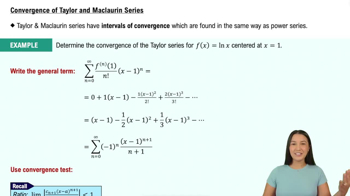
Convergence of Taylor & Maclaurin Series

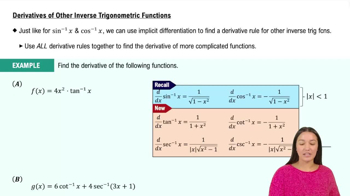
Derivatives of Inverse Trigonometric Functions

To find the Taylor series of f(x) = arctan(x/2), you need to compute derivatives of arctan and apply the chain rule. The derivatives of arctan(x) follow a known pattern, which helps in finding higher-order terms efficiently.
Video consigliato:
06:35
Derivatives of Other Inverse Trigonometric Functions

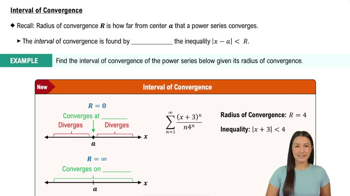
Interval of Convergence

The interval of convergence is the range of x-values for which the Taylor series converges to the function. For arctan(x/2), this depends on the radius of convergence determined by the series' ratio or root test, ensuring the series accurately represents the function within that interval.
Video consigliato:
08:44
Interval of Convergence
Pratica correlata
Domanda del libro di testo

Taylor series and interval of convergence


a. Use the definition of a Taylor/Maclaurin series to find the first four nonzero terms of the Taylor series for the given function centered at a.


f(x)=3ˣ, a=0

88
views

Domanda del libro di testo

Probability: sudden−death playoff Teams A and B go into suddendeath overtime after playing to a tie. The teams alternate possession of the ball, and the first team to score wins. Assume each team has a 1/6 chance of scoring when it has the ball, and Team A has the ball first.


a. The probability that Team A ultimately wins is ∑ₖ₌₀∞ (1/6)(5/6)²ᵏ. Evaluate this series.

51
views
Domanda del libro di testo

{Use of Tech} Binomial series


a. Find the first four nonzero terms of the binomial series centered at 0 for the given function.


f(x) = (1+x)⁻²/³; approximate 1.18⁻²/³.

54
views
Domanda del libro di testo

Explain why or why not Determine whether the following statements are true and give an explanation or counterexample.

a. The function f(x) = √x has a Taylor series centered at 0.

64
views
Domanda del libro di testo

{Use of Tech} Small argument approximations Consider the following common approximations when x is near zero. 


a. Estimate f(0.1) and give a bound on the error in the approximation.


f(x) = eˣ ≈ 1 + x

62
views
Domanda del libro di testo

Explain why or why not Determine whether the following statements are true and give an explanation or counterexample.


a. Only even powers of x appear in the Taylor polynomials for f(x)=e⁻²ˣ centered at 0.

63
views