
Ch. 11 - Power Series
Briggs - Calculus: Early Transcendentals 3rd Edition
Briggs3rd EditionCalculus: Early TranscendentalsISBN: 9780136847243Non è quello che usi tu?Cambia libro di testo
Capitolo 11, Problema 11.2.73

Exponential function In Section 11.3, we show that the power series for the exponential function centered at 0 is


eˣ = ∑ₖ₌₀∞ (xᵏ)/k!, for −∞ < x < ∞


Use the methods of this section to find the power series centered at 0 for the following functions. Give the interval of convergence for the resulting series.


f(x) = e⁻³ˣ

Guida verificata passo dopo passo
1
Recall the power series expansion for the exponential function centered at 0: \[e^{x} = \sum_{k=0}^{\infty} \frac{x^{k}}{k!}\] which converges for all real numbers \[x\] (i.e., the interval of convergence is \[(-\infty, \infty)\]).
To find the power series for \[f(x) = e^{-3x}\], substitute \[-3x\] in place of \[x\] in the original series. This gives: \[e^{-3x} = \sum_{k=0}^{\infty} \frac{(-3x)^{k}}{k!}\].
Rewrite the terms inside the summation to separate powers of \[x\] and constants: \[e^{-3x} = \sum_{k=0}^{\infty} \frac{(-3)^{k} x^{k}}{k!}\].
Since the original exponential series converges for all real numbers, replacing \[x\] by \[-3x\] does not change the radius of convergence. Therefore, the interval of convergence remains \[(-\infty, \infty)\].
Summarize the power series for \[f(x)\] as \[f(x) = \sum_{k=0}^{\infty} \frac{(-3)^{k}}{k!} x^{k}\] with interval of convergence \[(-\infty, \infty)\].

Risposta video verificata per un problema simile:

Questa soluzione video è stata consigliata dai nostri tutor come utile per risolvere questo problema.
Durata del video:
2m

Concetti chiave

Ecco i concetti essenziali che devi comprendere per rispondere correttamente alla domanda.

Power Series Representation of Functions

A power series expresses a function as an infinite sum of terms involving powers of the variable, typically centered at a point (here, 0). For example, the exponential function eˣ can be written as ∑ₖ₌₀∞ (xᵏ)/k!. Understanding this allows us to represent more complex functions by manipulating known series.
Video consigliato:
07:32
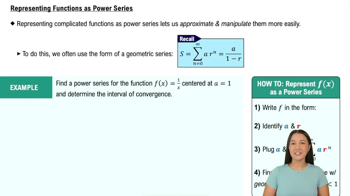
Representing Functions as Power Series

Substitution in Power Series

To find the power series of a function like f(x) = e⁻³ˣ, we substitute the inner expression (−3x) into the known series for eˣ. This means replacing x by −3x in the series, resulting in ∑ₖ₌₀∞ ((−3x)ᵏ)/k!. This technique helps generate new series from existing ones.
Video consigliato:
05:58
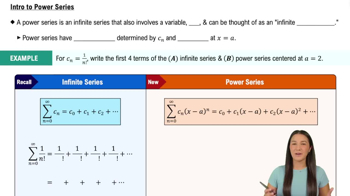
Intro to Power Series

Interval of Convergence

The interval of convergence is the set of x-values for which the power series converges to the function. For the exponential series, the interval is all real numbers (−∞, ∞). After substitution, it is important to verify if the interval changes, ensuring the series accurately represents the function within that domain.
Video consigliato:
08:44
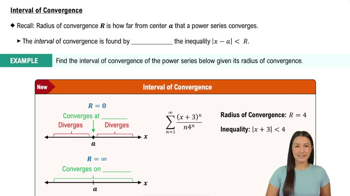
Interval of Convergence
Pratica correlata
Domanda del libro di testo

L'Hôpital's Rule by Taylor series Suppose f and g have Taylor series about the point a.

a. If f(a) = g(a) = 0 and g′(a) ≠ 0, evaluate lim ₓ→ₐ f(x)/g(x) by expanding f and g in their Taylor series. Show that the result is consistent withl’Hôpital’s Rule.

b. If f(a) = g(a) =f′(a) = g′(a) = 0 and g′′(a) ≠ 0, evaluate lim ₓ→ₐ f(x)/g(x) by expanding f and g in their Taylor series. Show that the result is consistent with two applications of 1'Hôpital's Rule.

55
views
Domanda del libro di testo

{Use of Tech} Maximum error Use the remainder term to find a bound on the error in the following approximations on the given interval. Error bounds are not unique.


tan x ≈ x on [−π/6, π/6]

89
views
Domanda del libro di testo

Radius and interval of convergence Determine the radius and interval of convergence of the following power series.


∑ₖ₌₁∞ (3x + 2)ᵏ/k

50
views
Domanda del libro di testo

Working with binomial series Use properties of power series, substitution, and factoring to find the first four nonzero terms of the Maclaurin series for the following functions. Use the Maclaurin series


(1 + x)⁻² = 1 − 2x + 3x² − 4x³ + ⋯, for −1 < x < 1.


(1 + 4x)⁻²

59
views
Domanda del libro di testo

Inverse sine Given the power series

1/√(1 − x²) = 1 + (1/2)x² + (1 ⋅ 3)/(2 ⋅ 4) x⁴ + (1 ⋅ 3 ⋅ 5)/(2 ⋅ 4 ⋅ 6) x⁶ +⋯

for −1<x<1, find the power series for f(x) = sin ⁻¹ x centered at 0.

65
views
Domanda del libro di testo

Limits Evaluate the following limits using Taylor series.

lim ₓ→₁ (x 1)/(ln x)

95
views