Ch. 11 - Power Series
Briggs - Calculus: Early Transcendentals 3rd Edition
Briggs3rd EditionCalculus: Early TranscendentalsISBN: 9780136847243Non è quello che usi tu?Cambia libro di testo
Capitolo 11, Problema 11.4.20

Limits Evaluate the following limits using Taylor series.
lim ₓ→₁ (x 1)/(ln x)

Guida verificata passo dopo passo
1
Identify the limit expression: \(\lim_{x \to 1} \frac{x - 1}{\ln x}\).
Recognize that both numerator and denominator approach 0 as \(x \to 1\), indicating an indeterminate form \(\frac{0}{0}\), which suggests using a series expansion or L'Hôpital's Rule.
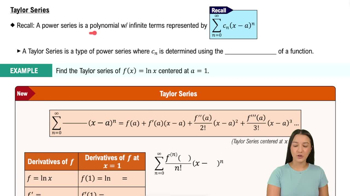
Expand \(\ln x\) around \(x = 1\) using the Taylor series: \(\ln x = (x - 1) - \frac{(x - 1)^2}{2} + \frac{(x - 1)^3}{3} - \cdots\).
Substitute the Taylor series expansion of \(\ln x\) into the limit expression to get \(\frac{x - 1}{(x - 1) - \frac{(x - 1)^2}{2} + \cdots}\).
Simplify the fraction by factoring out \((x - 1)\) in the denominator and canceling it with the numerator, then evaluate the limit as \(x \to 1\) by considering the leading terms.

Risposta video verificata per un problema simile:

Questa soluzione video è stata consigliata dai nostri tutor come utile per risolvere questo problema.
Durata del video:
3m

Concetti chiave

Ecco i concetti essenziali che devi comprendere per rispondere correttamente alla domanda.

Limits and Indeterminate Forms

Limits describe the behavior of a function as the input approaches a particular value. When direct substitution leads to expressions like 0/0 or ∞/∞, these are called indeterminate forms, requiring special techniques such as series expansions to evaluate the limit.
Video consigliato:
05:50
One-Sided Limits

Taylor Series Expansion

A Taylor series represents a function as an infinite sum of terms calculated from its derivatives at a single point. It approximates functions near that point, allowing complex expressions to be simplified and limits to be evaluated by examining leading terms.
Video consigliato:
08:42
Taylor Series

Logarithmic Function Behavior Near 1

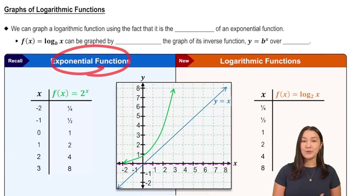
The natural logarithm function ln(x) behaves predictably near x = 1, where ln(1) = 0. Its Taylor series expansion around x = 1 starts as ln(x) ≈ (x - 1) - (x - 1)^2/2 + ..., which helps in simplifying limits involving ln(x) near 1.
Video consigliato:
5:26
Graphs of Logarithmic Functions
Pratica correlata
Domanda del libro di testo

 A useful substitution Replace x with x−1 in the series ln (1+x) = ∑ₖ₌₁∞ ((−1)ᵏ⁺¹ xᵏ)/k to obtain a power series for ln x centered at x = 1. What is the interval of convergence for the new power series?

65
views

Domanda del libro di testo

{Use of Tech} Maximum error Use the remainder term to find a bound on the error in the following approximations on the given interval. Error bounds are not unique.


tan x ≈ x on [−π/6, π/6]

89
views
Domanda del libro di testo

Exponential function In Section 11.3, we show that the power series for the exponential function centered at 0 is


eˣ = ∑ₖ₌₀∞ (xᵏ)/k!, for −∞ < x < ∞


Use the methods of this section to find the power series centered at 0 for the following functions. Give the interval of convergence for the resulting series.


f(x) = e⁻³ˣ

86
views
Domanda del libro di testo

Inverse sine Given the power series

1/√(1 − x²) = 1 + (1/2)x² + (1 ⋅ 3)/(2 ⋅ 4) x⁴ + (1 ⋅ 3 ⋅ 5)/(2 ⋅ 4 ⋅ 6) x⁶ +⋯

for −1<x<1, find the power series for f(x) = sin ⁻¹ x centered at 0.

65
views
Domanda del libro di testo

{Use of Tech} Number of terms What is the minimum order of the Taylor polynomial required to approximate the following quantities with an absolute error no greater than 10⁻³ ? (The answer depends on your choice of a center.)

ln 0.85

44
views
Domanda del libro di testo

{Use of Tech} Approximating powers Compute the coefficients for the Taylor series for the following functions about the given point a, and then use the first four terms of the series to approximate the given number.


f(x) = ∜x with a=16; approximate ∜13.

61
views