Ch. 11 - Power Series
Briggs - Calculus: Early Transcendentals 3rd Edition
Briggs3rd EditionCalculus: Early TranscendentalsISBN: 9780136847243Non è quello che usi tu?Cambia libro di testo
Capitolo 11, Problema 11.1.67f

Matching functions with polynomials Match functions a–f with Taylor polynomials A–F (all centered at 0). Give reasons for your choices.


f. e⁻²ˣ


A. p₂(x)= 1 + 2x + 2x²
B. p₂(x) = 1 − 6x + 24x²
C. p₂(x) = 1 + x − x²/2
D. p₂(x) = 1 − 2x + 4x²
E. p₂(x) = 1 − x + (3/2)x²
F. p₂(x) = 1 − 2x + 2x²

Guida verificata passo dopo passo
1
Recall that the Taylor polynomial of a function \(f(x)\) centered at 0 (Maclaurin polynomial) up to degree 2 is given by: \[p_2(x) = f(0) + f'(0)x + \frac{f''(0)}{2}x^2\]
Start by finding the derivatives of the function \(f(x) = e^{-2x}\): - First derivative: \[f'(x) = \frac{d}{dx} e^{-2x} = -2e^{-2x}\] - Second derivative: \[f''(x) = \frac{d}{dx} (-2e^{-2x}) = 4e^{-2x}\]
Evaluate the function and its derivatives at \(x=0\): - \(f(0) = e^0 = 1\) - \(f'(0) = -2e^0 = -2\) - \(f''(0) = 4e^0 = 4\)
Substitute these values into the Taylor polynomial formula: \[p_2(x) = 1 + (-2)x + \frac{4}{2}x^2 = 1 - 2x + 2x^2\]
Compare this polynomial with the given options and identify the matching polynomial for \(f(x) = e^{-2x}\).

Risposta video verificata per un problema simile:

Questa soluzione video è stata consigliata dai nostri tutor come utile per risolvere questo problema.
Durata del video:
2m

Concetti chiave

Ecco i concetti essenziali che devi comprendere per rispondere correttamente alla domanda.

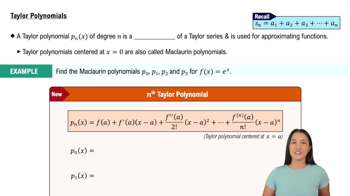
Taylor Polynomials

Taylor polynomials approximate functions near a specific point (here, 0) using derivatives. The nth-degree Taylor polynomial uses the function's value and its first n derivatives at the center to build a polynomial that closely matches the function locally.
Video consigliato:
07:00
Taylor Polynomials

Derivatives and Their Role in Taylor Series

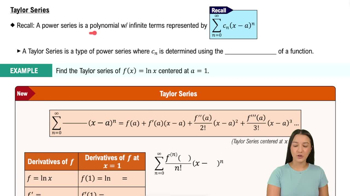
The coefficients of a Taylor polynomial come from the function's derivatives at the center point. Specifically, the coefficient of x^k is the kth derivative at 0 divided by k factorial, reflecting how the function's slope, curvature, and higher changes shape the polynomial.
Video consigliato:
08:42
Taylor Series

Matching Functions to Polynomials Using Derivative Values

To match a function with its Taylor polynomial, calculate the function's value and first two derivatives at 0, then compare these to the polynomial's coefficients. This ensures the polynomial accurately represents the function's behavior near the center.
Video consigliato:
Percorso guidato
06:37
Average Value of a Function