
Ch. 11 - Power Series
Briggs - Calculus: Early Transcendentals 3rd Edition
Briggs3rd EditionCalculus: Early TranscendentalsISBN: 9780136847243Non è quello che usi tu?Cambia libro di testo
Capitolo 11, Problema 11.1.45

Remainders Find the remainder Rₙ for the nth−order Taylor polynomial centered at a for the given functions. Express the result for a general value of n.


f(x) = sin x, a = π/2

Guida verificata passo dopo passo
1
Recall that the remainder term \( R_n(x) \) for the nth-order Taylor polynomial of a function \( f(x) \) centered at \( a \) is given by the Lagrange form of the remainder: \[ R_n(x) = \frac{f^{(n+1)}(c)}{(n+1)!} (x - a)^{n+1} \] where \( c \) is some value between \( a \) and \( x \).
Identify the function and the center: here, \( f(x) = \sin x \) and \( a = \frac{\pi}{2} \). We need to find the \( (n+1) \)-th derivative of \( \sin x \).
Determine the pattern of derivatives of \( \sin x \): \[ f(x) = \sin x \] \[ f'(x) = \cos x \] \[ f''(x) = -\sin x \] \[ f^{(3)}(x) = -\cos x \] \[ f^{(4)}(x) = \sin x \] Notice the derivatives repeat every 4 steps. Use this cyclic pattern to express \( f^{(n+1)}(x) \) in terms of \( \sin x \) or \( \cos x \) with appropriate signs.
Evaluate \( f^{(n+1)}(c) \) at some \( c \) between \( a = \frac{\pi}{2} \) and \( x \). Since \( c \) is unknown but lies in this interval, keep \( f^{(n+1)}(c) \) in the expression to represent the remainder.
Write the remainder term explicitly as: \[ R_n(x) = \frac{f^{(n+1)}(c)}{(n+1)!} (x - \frac{\pi}{2})^{n+1} \] where \( f^{(n+1)}(c) \) follows the derivative pattern of \( \sin x \) and \( c \) is between \( \frac{\pi}{2} \) and \( x \). This expression represents the remainder for the nth-order Taylor polynomial centered at \( \frac{\pi}{2} \).

Risposta video verificata per un problema simile:

Questa soluzione video è stata consigliata dai nostri tutor come utile per risolvere questo problema.
Durata del video:
5m

Concetti chiave

Ecco i concetti essenziali che devi comprendere per rispondere correttamente alla domanda.

Taylor Polynomial and Taylor Series

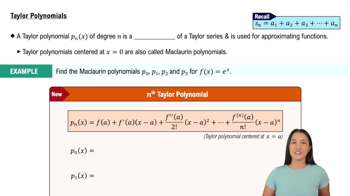
A Taylor polynomial approximates a function near a point a using derivatives of the function at a. The nth-order Taylor polynomial includes terms up to the nth derivative, providing a polynomial approximation of the function around a. Understanding this helps in constructing the polynomial for sin x centered at π/2.
Video consigliato:
07:00
Taylor Polynomials

Remainder Term (Lagrange Form)

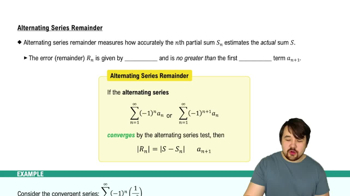
The remainder term Rₙ measures the error between the actual function and its nth-order Taylor polynomial. The Lagrange form expresses Rₙ as a function involving the (n+1)th derivative evaluated at some point between a and x, helping to bound or express the error explicitly.
Video consigliato:
Percorso guidato
06:32
Alternating Series Remainder

Derivatives of sin x and their Patterns

The derivatives of sin x cycle every four steps: sin x, cos x, -sin x, -cos x, then repeat. Recognizing this pattern is essential to find the (n+1)th derivative needed for the remainder term when centered at π/2, simplifying the expression of Rₙ.
Video consigliato:
04:56
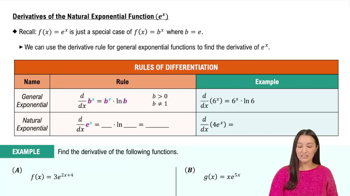
Derivative of the Natural Exponential Function (e^x)
Pratica correlata
Domanda del libro di testo

{Use of Tech} Newton's derivation of the sine and arcsine series Newton discovered the binomial series and then used it ingeniously to obtain many more results. Here is a case in point.

a. Referring to the figure, show that x = sin s or s = sin ⁻¹ x.

b. The area of a circular sector of radius r subtended by an angle θ is 1/2r²θ. Show that the area of the circular sector APE is s/2, which implies that

s = 2 ∫₀ˣ √(1 − t²) dt − x √(1 −x²)

c. Use the binomial series for f(x) = √(1 − x²) to obtain the first few terms of the Taylor series for s=sin ⁻¹ x.

d. Newton next inverted the series in part (c) to obtain the Taylor series for x=sin s. He did this by assuming sin s = ∑ aₖ sᵏ and solving x = sin(sin ⁻¹ x) for the coefficients aₖ. Find the first few terms of the Taylor series for sin s using this idea (a computer algebra system might be helpful as well).

124
views
Domanda del libro di testo

Derivative trick Here is an alternative way to evaluate higher derivatives of a function f that may save time. Suppose you can find the Taylor series for f centered at the point a without evaluating derivatives (for example, from a known series). Then f⁽ᵏ⁾(a)=k! multiplied by the coefficient of (x−a)ᵏ. Use this idea to evaluate f⁽³⁾(0) and f⁽⁴⁾(0) for the following functions. Use known series and do not evaluate derivatives.


f(x) = ∫₀ˣ sin t² dt

74
views
Domanda del libro di testo

Radius and interval of convergence Determine the radius and interval of convergence of the following power series.

∑ₖ₌₀∞ k(x−1)ᵏ

71
views
Domanda del libro di testo

Power series for derivatives


a. Differentiate the Taylor series centered at 0 for the following functions.

b. Identify the function represented by the differentiated series.

c. Give the interval of convergence of the power series for the derivative.


f(x) = eˣ

47
views
Domanda del libro di testo

Does the accuracy of an approximation given by a Taylor polynomial generally increase or decrease with the order of the approximation? Explain.

84
views
Domanda del libro di testo

Limits Evaluate the following limits using Taylor series.

lim ₓ→₄ (x² 16)/(ln (x 3)}

75
views