
Ch. 11 - Power Series
Briggs - Calculus: Early Transcendentals 3rd Edition
Briggs3rd EditionCalculus: Early TranscendentalsISBN: 9780136847243Non è quello che usi tu?Cambia libro di testo
Capitolo 11, Problema 11.4.78a

Sine integral function The function Si(x) = ∫₀ˣ f(t) dt, where f(t) = {(sin t)/t if t ≠ 0, 1 if t = 0, is called the sine integral function.
a. Expand the integrand in a Taylor series centered at 0.

Guida verificata passo dopo passo
1
Recall the definition of the sine integral function: \(\mathrm{Si}(x) = \int_0^x f(t) \, dt\), where \(f(t) = \frac{\sin t}{t}\) for \(t \neq 0\) and \(f(0) = 1\).
To find the Taylor series expansion of the integrand \(f(t)\) centered at 0, start with the Taylor series expansion of \(\sin t\) around 0: \(\sin t = \sum_{n=0}^\infty (-1)^n \frac{t^{2n+1}}{(2n+1)!}\).
Divide the series for \(\sin t\) by \(t\) to get the series for \(f(t) = \frac{\sin t}{t}\): \(f(t) = \sum_{n=0}^\infty (-1)^n \frac{t^{2n}}{(2n+1)!}\).
Note that this series is valid for all \(t\) including \(t=0\) because the term for \(n=0\) is \(\frac{t^0}{1!} = 1\), which matches the given \(f(0) = 1\).
Thus, the Taylor series expansion of the integrand \(f(t)\) centered at 0 is \(f(t) = 1 - \frac{t^2}{3!} + \frac{t^4}{5!} - \frac{t^6}{7!} + \cdots\).

Risposta video verificata per un problema simile:

Questa soluzione video è stata consigliata dai nostri tutor come utile per risolvere questo problema.
Durata del video:
1m

Concetti chiave

Ecco i concetti essenziali che devi comprendere per rispondere correttamente alla domanda.

Sine Integral Function

The sine integral function Si(x) is defined as the integral from 0 to x of (sin t)/t dt, with a special value at t = 0 to ensure continuity. It is important to understand this function as an example of an integral involving a non-elementary integrand that requires special handling at singular points.
Video consigliato:
Percorso guidato
5:53
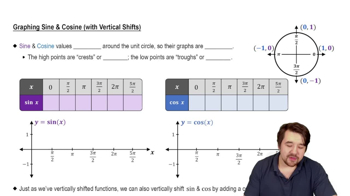
Graph of Sine and Cosine Function

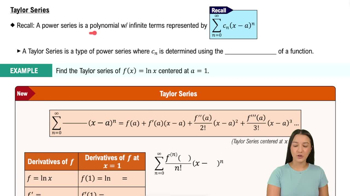
Taylor Series Expansion

A Taylor series represents a function as an infinite sum of terms calculated from the derivatives at a single point, usually zero. Expanding the integrand (sin t)/t in a Taylor series centered at 0 involves expressing sin t as its power series and dividing by t, carefully handling the limit at t = 0.
Video consigliato:
08:42
Taylor Series

Handling Indeterminate Forms and Continuity

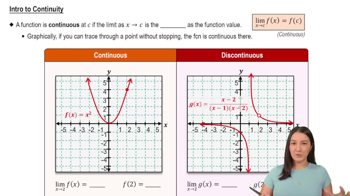
Since (sin t)/t is undefined at t = 0, understanding limits and continuity is essential. Using the limit lim_{t→0} (sin t)/t = 1 ensures the function is well-defined and continuous at zero, which is crucial for correctly expanding the integrand in a Taylor series.
Video consigliato:
05:34
Intro to Continuity
Pratica correlata
Domanda del libro di testo

Probability: sudden−death playoff Teams A and B go into suddendeath overtime after playing to a tie. The teams alternate possession of the ball, and the first team to score wins. Assume each team has a 1/6 chance of scoring when it has the ball, and Team A has the ball first.


a. The probability that Team A ultimately wins is ∑ₖ₌₀∞ (1/6)(5/6)²ᵏ. Evaluate this series.

51
views
Domanda del libro di testo

{Use of Tech} Binomial series


a. Find the first four nonzero terms of the binomial series centered at 0 for the given function.


f(x) = (1+x)⁻²/³; approximate 1.18⁻²/³.

54
views
Domanda del libro di testo

Taylor series


a. Use the definition of a Taylor series to find the first four nonzero terms of the Taylor series for the given function centered at a.


f(x) = 1/x, a = 1

59
views
Domanda del libro di testo

Taylor series and interval of convergence


a. Use the definition of a Taylor/Maclaurin series to find the first four nonzero terms of the Taylor series for the given function centered at a.


f(x) = cosh 3x, a = 0

31
views
Domanda del libro di testo

{Use of Tech} Fresnel integrals The theory of optics gives rise to the two Fresnel integrals

S(x) = ∫₀ˣ sin t² dt and C(x) = ∫₀ˣ cos t² dt

a. Compute S′(x) and C′(x).

95
views
Domanda del libro di testo

Explain why or why not Determine whether the following statements are true and give an explanation or counterexample.


a. Only even powers of x appear in the Taylor polynomials for f(x)=e⁻²ˣ centered at 0.

63
views