Ch. 11 - Power Series
Briggs - Calculus: Early Transcendentals 3rd Edition
Briggs3rd EditionCalculus: Early TranscendentalsISBN: 9780136847243Non è quello che usi tu?Cambia libro di testo
Capitolo 11, Problema 11.1.47

{Use of Tech} Estimating errors Use the remainder to find a bound on the error in approximating the following quantities with the nth-order Taylor polynomial centered at 0. Estimates are not unique.


sin 0.3, n = 4

Guida verificata passo dopo passo
1
Identify the function and the point of expansion: here, the function is \(f(x) = \sin x\), and the Taylor polynomial is centered at \(0\) (Maclaurin series).
Recall the Taylor series for \(\sin x\) centered at \(0\): \(\sin x = \sum_{k=0}^{\infty} (-1)^k \frac{x^{2k+1}}{(2k+1)!}\). The 4th-order Taylor polynomial means including terms up to degree 4, which for \(\sin x\) corresponds to terms up to \(x^3\) because the series has only odd powers.
Determine the remainder term (Lagrange form) for the Taylor polynomial of order \(n=4\) centered at 0: \(R_n(x) = \frac{f^{(n+1)}(c)}{(n+1)!} x^{n+1}\), where \(c\) is some value between \(0\) and \(x\).
Since \(n=4\), the remainder involves the 5th derivative of \(\sin x\). Find \(f^{(5)}(x)\) and note its maximum absolute value on the interval between \(0\) and \(0.3\) to bound the error.
Use the bound on \(|f^{(5)}(c)|\) and plug into the remainder formula: \(|R_4(0.3)| \leq \frac{M}{5!} |0.3|^5\), where \(M\) is the maximum of \(|f^{(5)}(c)|\) for \(c\) in \([0, 0.3]\). This gives a bound on the error in approximating \(\sin 0.3\) by the 4th-order Taylor polynomial.

Risposta video verificata per un problema simile:

Questa soluzione video è stata consigliata dai nostri tutor come utile per risolvere questo problema.
Durata del video:
4m

Concetti chiave

Ecco i concetti essenziali che devi comprendere per rispondere correttamente alla domanda.

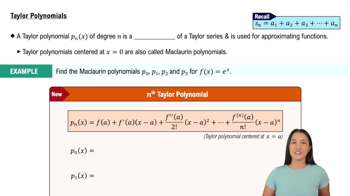
Taylor Polynomial Approximation

A Taylor polynomial approximates a function near a point using a finite sum of its derivatives at that point. The nth-order Taylor polynomial centered at 0 (Maclaurin polynomial) uses derivatives up to order n to estimate the function's value close to zero.
Video consigliato:
07:00
Taylor Polynomials

Remainder (Error) Term in Taylor Series

The remainder term quantifies the difference between the actual function value and its Taylor polynomial approximation. It provides an upper bound on the error, ensuring the approximation's accuracy within a specified range.
Video consigliato:
08:42
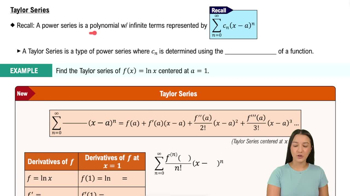
Taylor Series

Bounding the Error for sin(x)

For sin(x), the remainder after the nth-order polynomial can be bounded using the next derivative's maximum value on the interval. Since derivatives of sin(x) are bounded by 1, this helps estimate the maximum possible error when approximating sin(0.3) with a 4th-order polynomial.
Video consigliato:
Percorso guidato
04:57
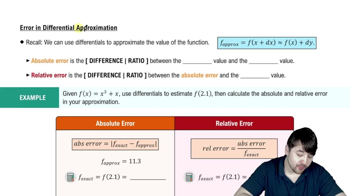
Determining Error and Relative Error
Pratica correlata
Domanda del libro di testo

Radius and interval of convergence Determine the radius and interval of convergence of the following power series.


∑ₖ₌₀∞ (2x)ᵏ

34
views

Domanda del libro di testo

Suppose you know the Maclaurin series for f and that it converges to f(x) for |x|<1. How do you find the Maclaurin series for f(x²) and where does it converge?

67
views
Domanda del libro di testo

{Use of Tech} A different kind of approximation When approximating a function f using a Taylor polynomial, we use information about f and its derivative at one point. An alternative approach (called interpolation) uses information about f at several different points. Suppose we wish to approximate f(x)=sin x on the interval [0, π].


a. Write the (quadratic) Taylor polynomial p₂ for f centered at π/2.


b. Now consider a quadratic interpolating polynomial q(x) = ax² + bx + c. The coefficients a, b, and c are chosen such that the following conditions are satisfied:

q(0) = f(0), q(π/2) = f(π/2), and q(π) = f(π)


Show that q(x) = −(4/π²)x² + (4/π)x.


c. Graph f, p₂, and q on [0, π].


d. Find the error in approximating f(x) = sin x at the points π/4, π/2, 3π/4, and π using p₂ and q.


e. Which function, p₂ or q, is a better approximation to f on [0, π]? Explain.

52
views
Domanda del libro di testo

{Use of Tech} Estimating errors Use the remainder to find a bound on the error in approximating the following quantities with the nth-order Taylor polynomial centered at 0. Estimates are not unique.


ln 1.04, n=3

65
views
Domanda del libro di testo

Derivative trick Here is an alternative way to evaluate higher derivatives of a function f that may save time. Suppose you can find the Taylor series for f centered at the point a without evaluating derivatives (for example, from a known series). Then f⁽ᵏ⁾(a)=k! multiplied by the coefficient of (x−a)ᵏ. Use this idea to evaluate f⁽³⁾(0) and f⁽⁴⁾(0) for the following functions. Use known series and do not evaluate derivatives.


f(x) = eᶜᵒˢ ˣ

107
views
Domanda del libro di testo

{Use of Tech} Approximating sin x Let f(x)=sin x, and let pₙ and qₙ be nth−order Taylor polynomials for f centered at 0 and π, respectively.

a. Find p₅ and q₅

b. Graph f, p₅, and q₅ on the interval [−π, 2π]. On what interval is p₅ a better approximation to f than q₅? On what interval is q₅ a better approximation to f than p₅?

c. Complete the following table showing the errors in the approximations given by p₅ and q₅ at selected points.

d. At which points in the table is p₅ a better approximation to f than q₅? At which points do p₅ and q₅ give equal approximations to f? Explain your observations.

41
views