Ch. 2 - Limits
Briggs - Calculus: Early Transcendentals 3rd Edition
Briggs3rd EditionCalculus: Early TranscendentalsISBN: 9780136847243Non è quello che usi tu?Cambia libro di testo
Capitolo 2, Problema 2.31b

A projectile is fired vertically upward and has a position given by s(t)=−16t^2+128t+192, for 0≤t≤9.


b. From the graph of the position function, identify the time at which the projectile has an instantaneous velocity of zero; call this time t=a.

Guida verificata passo dopo passo
1
insert step 1: Understand that the instantaneous velocity of the projectile is given by the derivative of the position function s(t).
insert step 2: Differentiate the position function s(t) = -16t^2 + 128t + 192 with respect to t to find the velocity function v(t).
insert step 3: Set the velocity function v(t) equal to zero to find the time when the projectile has an instantaneous velocity of zero.
insert step 4: Solve the equation from step 3 for t to find the value of t = a.
insert step 5: Verify that the value of t = a is within the given interval 0 ≤ t ≤ 9.

Risposta video verificata per un problema simile:

Questa soluzione video è stata consigliata dai nostri tutor come utile per risolvere questo problema.
Durata del video:
2m

Concetti chiave

Ecco i concetti essenziali che devi comprendere per rispondere correttamente alla domanda.

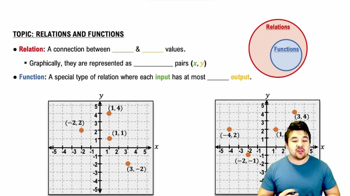
Position Function

The position function describes the location of an object at any given time. In this case, s(t) = -16t^2 + 128t + 192 represents the height of a projectile over time, where 't' is the time in seconds. Understanding this function is crucial for analyzing the projectile's motion and determining its behavior at different time intervals.
Video consigliato:
Percorso guidato
5:20
Relations and Functions

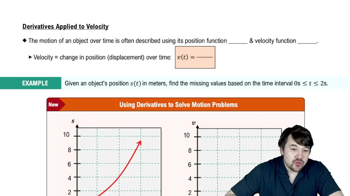
Instantaneous Velocity

Instantaneous velocity is the rate of change of the position function with respect to time, represented mathematically as the derivative of the position function, s'(t). For the given position function, finding the time when the instantaneous velocity is zero involves calculating the derivative and solving for t when s'(t) = 0, indicating the moment the projectile reaches its peak height.
Video consigliato:
Percorso guidato
06:29
Derivatives Applied To Velocity

Critical Points

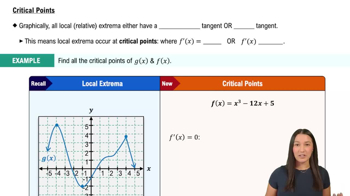
Critical points occur where the derivative of a function is zero or undefined, indicating potential maxima, minima, or points of inflection. In the context of the projectile's motion, identifying the critical points of the velocity function helps determine when the projectile stops ascending and starts descending, which is essential for understanding its overall trajectory.
Video consigliato:
04:50
Critical Points