Ch. 2 - Limits
Briggs - Calculus: Early Transcendentals 3rd Edition
Briggs3rd EditionCalculus: Early TranscendentalsISBN: 9780136847243Non è quello che usi tu?Cambia libro di testo
Capitolo 2, Problema 2.5.55b

Complete the following steps for the given functions. 


b. Find the vertical asymptotes of ff (if any).


f(x)=4x3+4x2+7x+4x2+1f\(\left\)(x\(\right\))=\(\frac{4x^3+4x^2+7x+4}{x^2+1}\)

Guida verificata passo dopo passo
1
Identify the function given: \( f(x) = \frac{4x^3 + 4x^2 + 7x + 4}{x^2 + 1} \). This is a rational function, which is a ratio of two polynomials.
To find vertical asymptotes, we need to determine where the denominator is equal to zero, as these are the points where the function is undefined.
Set the denominator equal to zero: \( x^2 + 1 = 0 \).
Solve the equation \( x^2 + 1 = 0 \) for \( x \). Notice that \( x^2 = -1 \), which has no real solutions since the square of a real number cannot be negative.
Conclude that there are no vertical asymptotes for the function \( f(x) = \frac{4x^3 + 4x^2 + 7x + 4}{x^2 + 1} \) because the denominator does not have any real roots.

Risposta video verificata per un problema simile:

Questa soluzione video è stata consigliata dai nostri tutor come utile per risolvere questo problema.
Durata del video:
2m

Concetti chiave

Ecco i concetti essenziali che devi comprendere per rispondere correttamente alla domanda.

Vertical Asymptotes

Vertical asymptotes occur in rational functions where the denominator approaches zero while the numerator does not. These points indicate where the function's value tends to infinity or negative infinity, leading to a discontinuity. To find vertical asymptotes, set the denominator equal to zero and solve for the variable, ensuring that the numerator does not also equal zero at those points.
Video consigliato:
Percorso guidato
5:50
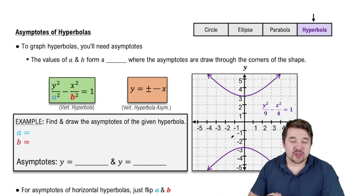
Asymptotes of Hyperbolas

Rational Functions

A rational function is a function represented by the ratio of two polynomials. The general form is f(x) = P(x)/Q(x), where P and Q are polynomials. Understanding the behavior of rational functions is crucial for analyzing their asymptotic behavior, including identifying vertical and horizontal asymptotes, as well as points of discontinuity.
Video consigliato:
6:04
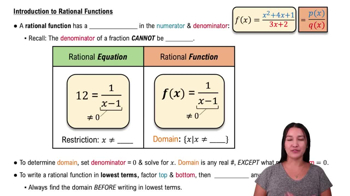
Intro to Rational Functions

Polynomial Functions

Polynomial functions are expressions that consist of variables raised to non-negative integer powers, combined using addition, subtraction, and multiplication. They play a significant role in calculus, particularly in determining the behavior of rational functions. The degree of the polynomial affects the function's end behavior and can influence the presence of asymptotes.
Video consigliato:
07:00
Taylor Polynomials