Ch. 2 - Limits
Briggs - Calculus: Early Transcendentals 3rd Edition
Briggs3rd EditionCalculus: Early TranscendentalsISBN: 9780136847243Non è quello che usi tu?Cambia libro di testo
Capitolo 2, Problema 79

A right circular cylinder with a height of 10 cm and a surface area of S cm2 has a radius given by r(S)=1/2(√100+2S/π −10).
Find lim S→0^+ r(S) and interpret your result.

Guida verificata passo dopo passo
1
Identify the function for the radius: \( r(S) = \frac{1}{2}(\sqrt{100 + \frac{2S}{\pi}} - 10) \).
Understand that you need to find \( \lim_{S \to 0^+} r(S) \).
Substitute \( S = 0 \) into the function: \( r(0) = \frac{1}{2}(\sqrt{100 + \frac{2 \cdot 0}{\pi}} - 10) \).
Simplify the expression: \( r(0) = \frac{1}{2}(\sqrt{100} - 10) \).
Calculate the limit by evaluating the simplified expression.

Risposta video verificata per un problema simile:

Questa soluzione video è stata consigliata dai nostri tutor come utile per risolvere questo problema.
Durata del video:
3m

Concetti chiave

Ecco i concetti essenziali che devi comprendere per rispondere correttamente alla domanda.

Limits

In calculus, a limit describes the behavior of a function as its input approaches a certain value. It is essential for understanding continuity, derivatives, and integrals. In this context, we are interested in the limit of the radius function r(S) as S approaches 0 from the positive side, which helps us determine the behavior of the radius when the surface area is minimal.
Video consigliato:
05:50
One-Sided Limits

Surface Area of a Cylinder

The surface area of a right circular cylinder is calculated using the formula S = 2πr(h + r), where r is the radius and h is the height. This concept is crucial for understanding how the radius r(S) is derived from the surface area S, and it provides context for the relationship between the dimensions of the cylinder and its surface area.
Video consigliato:
09:07
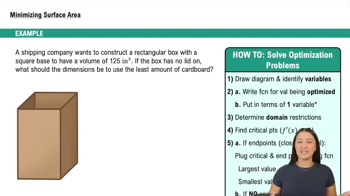
Example 1: Minimizing Surface Area

Function Interpretation

Interpreting the result of a limit involves understanding what the limit signifies in the context of the problem. In this case, finding lim S→0^+ r(S) will reveal the radius of the cylinder as the surface area approaches zero, which can provide insights into the geometric implications of a cylinder with minimal surface area, such as its shape and dimensions.
Video consigliato:
04:39
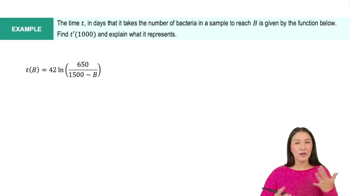
Derivative of the Natural Logarithmic Function Example 7